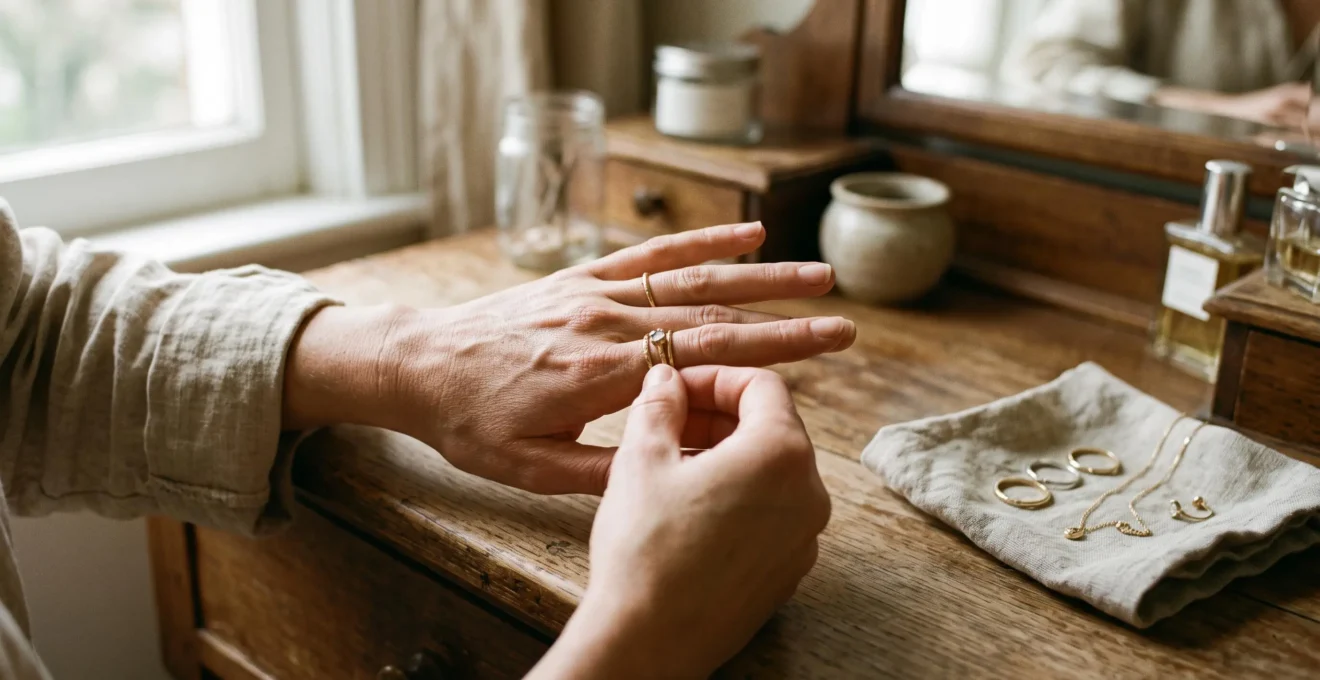
Three delicate rings can look beautifully composed in the morning and become surprisingly distracting by lunchtime. A band shifts while typing, a gemstone catches on a sleeve, or several fine rings begin to feel tighter than any of them would individually. The problem is rarely solved by simply choosing thinner jewellery.
To stack thin rings comfortably, start with one focal ring, frame it with two quieter bands, and assess the entire combination as a single fitting arrangement. Leave enough visual distinction between the pieces, keep their profiles compatible, and consider what your hands actually do throughout the day.
A balanced stack is not necessarily symmetrical, monochromatic or limited to one finger. Deliberate contrast can work extremely well. What matters is controlling where the eye settles and how the jewellery behaves when your fingers bend, grip, wash and move.
The following methods combine practical styling techniques with jewellery-fitting guidance and realistic care habits, so the result remains attractive beyond the initial photograph.
Thin Ring Stacking: The Essentials
- Build around one focal point. Start with a textured or stone-set hero ring and add simpler bands that support rather than compete with it.
- Fit the complete stack. Several narrow rings can feel tighter together, so assess their combined width and comfort before committing to daily wear.
- Match the stack to your routine. Check for pressure, trapped moisture, snagging and jewellery contact, and remove delicate pieces before activities that could damage them.
- Why Do Stacked Rings Look Messy on Some Hands Even When The Rings Are Delicate?
- How to Build a Ring Stack Using One Hero Ring and 2 Spacers So It Looks Clean
- Which Looks More Balanced: Stacking Rings on One Finger or Spreading Them Across 3 Fingers?
- The Ring Stacking Mistake That Causes Pinching and Skin Irritation During a Full Workday
- When Should You Skip Ring Stacks to Avoid Losing Jewellery or Damaging Stones?
- How to Layer 3 Fine Chains Using a 2-Inch Spacing Rule So They Stop Tangling
- How to Choose Functional Accessories Using a 3-Constraint Filter So You Stop Buying “Almost Right” Items
- How Can Functional Accessories Actually Improve Your Day and Still Look Stylish After 8 Hours?
Why Do Stacked Rings Look Messy on Some Hands Even When The Rings Are Delicate?
Thin rings can look cluttered when their visual details compete instead of forming a coherent arrangement. Several narrow bands may still create a busy effect if gemstone heights, textures, widths and finishes interrupt the eye’s movement across the hand. The solution is to organise visual weight, not automatically remove every extra ring.
Imagine three very fine bands: one mirror-polished, one heavily engraved and one holding a raised gemstone. Individually, each appears delicate. Together, the different reflections, textures and elevations may create several competing focal points. The eye has no obvious place to settle.
By contrast, a slightly wider central ring accompanied by two plain bands can look calmer because its hierarchy is immediately understandable. Visual clarity depends on the relationship between the pieces, rather than on band thickness alone.
The GIA‘s ring stacking guide discusses balancing band widths, textures, gemstones, metal colours and finger placement. Its guidance supports intentional combinations, including mixed metals, rather than treating contrast as an automatic styling error.
A useful styling exercise is the arm’s-length photograph test. Photograph your hand in ordinary daylight, with the fingers relaxed. View the image at a small size and narrow your eyes slightly. Can you distinguish the main ring and the supporting lines, or does everything merge into one reflective patch?
This is a subjective visual check, not a scientifically validated assessment. It is particularly helpful when choosing between arrangements that appear equally attractive at close range.
Hand proportions also influence the impression. Longer fingers may offer more visible space for separated details, while shorter fingers can benefit from a continuous line of similar-width bands and aligned stone settings. These are aesthetic starting points, not restrictions based on hand shape.
For a shorter finger, try three low-profile rings in related widths before introducing a tall setting. For a longer finger, experiment with a textured centre and more visible variation between surrounding bands. In both cases, adjust the arrangement according to the actual space available when the finger bends.
The same principle applies to finishes. A highly polished ring beside an oxidised or deeply textured band can create a compelling contrast. Problems arise when several equally prominent finishes compete without a dominant piece. Choose one leading finish and let the remaining surfaces provide quieter support.
Once the dominant line is clear, selecting the individual rings becomes simpler: every additional piece should either frame that line, extend it or introduce a contrast you deliberately want.
How to Build a Ring Stack Using One Hero Ring and 2 Spacers So It Looks Clean
A clean three-ring stack starts with one hero ring and two visually quieter spacer bands. Choose the most distinctive piece first, then place narrower, simpler rings around it to establish an intentional rhythm. The arrangement should be evaluated for both visual spacing and combined fit, because three individually comfortable rings may become restrictive when worn together.
The hero ring provides the composition’s anchor. It might have a small gemstone, an engraved surface, a shaped silhouette or a distinctive finish. It does not need to be expensive or dramatically larger; it simply needs to be the piece that attracts attention first.
The two supporting bands should frame that feature without introducing equally strong details. Smooth surfaces, simple edges and consistent metal tones are reliable starting points.
For example, a hypothetical everyday combination might use a slim textured gold ring with a small flush-set stone between two narrower polished gold bands. The central texture creates interest, while the surrounding surfaces provide continuity.
Flush-fitting profiles matter as much as visual simplicity. If a raised setting or protruding detail prevents adjacent bands from sitting naturally, forcing the rings together can create uneven gaps and unwanted contact. A shaped or contoured spacer may be more suitable than a perfectly straight band.
Mixed metals can also work. A silver-toned hero ring framed by two warm-toned bands creates a deliberate contrast, while placing one contrasting spacer beside an otherwise matching pair offers a more restrained effect. Neither approach is inherently superior; select the one that makes the intended focal point obvious.
The method becomes repeatable when the sequence follows a recognisable pattern. If the three-ring foundation works, another plain band can extend its visual rhythm. Avoid adding a distinctive new ring solely because space remains available.
Fit requires a separate decision. GIA’s technical guidance differentiates narrow-band sizing from wider-band sizing and notes that bridal sets exceeding approximately 4–5 mm in combined width require particular fitting consideration. That measurement concerns fitting technique, not a universal discomfort threshold.
A professional can evaluate your intended combination using GIA’s technical ring-sizing reference as a guide to the relevant construction and sizing principles.
Do not automatically increase every ring by half a size. Finger shape, knuckle dimensions, individual profiles and combined width influence fit. The correct arrangement should pass over the knuckle securely without creating sustained pressure at the base of the finger.
Build and Check Your Three-Ring Stack
- Select one hero ring. Place your most distinctive piece on a jewellery tray and identify its primary feature: gemstone, texture, shape or finish.
- Choose two quieter spacers. Arrange them beside the hero and confirm that neither introduces a competing focal point.
- Check the physical profiles. Place all three rings together and identify any protruding settings, forced gaps or direct gemstone-to-metal contact.
- Test the intended finger. Wear the complete combination, bend your hand and check that it moves comfortably and remains secure over the knuckle.
- Record the final arrangement. Take a daylight photograph and note the exact ring order, so the combination can be recreated consistently.
A successful foundation should feel considered without requiring constant rearrangement. After it works on one finger, the next decision is whether distributing rings across the hand would improve the overall composition.
Which Looks More Balanced: Stacking Rings on One Finger or Spreading Them Across 3 Fingers?
One-finger stacking usually creates a stronger, more concentrated focal point, while distributing rings across three fingers creates a broader, more open composition. Neither is universally more balanced or comfortable. The better option depends on finger proportions, ring profiles, overall styling and the activities your hands perform throughout the day.
A concentrated stack works well when the rings form a recognisable group. Three coordinating bands on one finger can read almost like a single designed piece, particularly when a central stone or texture establishes a clear hierarchy.
A spread arrangement introduces visual pauses between pieces. One delicate band on each of three fingers can make the hand appear less heavily adorned at any single point, although the total number of visible details remains the same.
Clothing can influence the choice. Bold sleeves, textured knitwear or multiple bracelets already add visual activity near the hands. A concentrated ring stack may provide one clear jewellery focal point. With simpler sleeves, a distributed arrangement can bring visual interest across the hand.
Daily practicality is more individual. A concentrated stack may keep decorative details in one location, but it also creates greater combined width and potentially more pressure around that finger. Distributed rings avoid that concentration while introducing additional contact points with objects, adjacent fingers and gloves.
The following comparison offers practical starting points rather than experimentally established performance rankings.
| Consideration | One-finger stack | Three-finger arrangement |
|---|---|---|
| Visual focus | One concentrated focal point | Interest distributed across the hand |
| Proportion | Emphasises one finger and the combined ring silhouette | Creates more separation between individual details |
| Fit | Requires attention to cumulative band width | Requires a suitable fit on each chosen finger |
| Typing and desk work | May concentrate contact or pressure on one finger | May create more opportunities for contact with nearby objects |
| Gloves and manual tasks | Multiple bands may catch or shift together | Several individual rings may complicate glove use |
| Styling flexibility | Easy to present as one coordinated group | Easy to adjust the visual distribution independently |
For frequent typing, neither arrangement should be assumed automatically safer or more comfortable. Test the exact rings during ordinary keyboard use. Notice whether bands contact the desk, move when you grip a mouse or press uncomfortably against adjacent fingers.
The same applies to cooking and childcare. Rings with projecting settings can snag regardless of placement, and physically demanding tasks may justify removing delicate jewellery altogether.
A useful compromise is two rings on one finger and one ring on an adjacent finger. The pair creates a primary focal point, while the separate band continues the design without requiring a full three-ring stack on one finger.
For instance, place a hero ring beside a plain spacer on your ring finger, then add a slim coordinating band to the middle finger. If the metal tones and profiles relate, the arrangement appears connected without being identical.
Whichever arrangement suits your hand, comfort must remain an independent test. A visually excellent composition loses its practical value if the rings repeatedly pinch, rotate against the skin or trap moisture.
The Ring Stacking Mistake That Causes Pinching and Skin Irritation During a Full Workday
The key mistake is treating several rings as independent accessories when they actually share pressure, movement and contact with the skin. Combined width can make the fit restrictive, neighbouring bands may rub against one another, and retained moisture or soap may irritate the skin. These mechanisms require different solutions, so discomfort should not automatically be blamed on ring size or metal allergy alone.
Consider two rings with incompatible profiles: a stone-set band beside a smooth, delicate spacer. As the hand moves, the pieces may touch repeatedly. Depending on their materials and construction, that contact can contribute to surface wear, particularly on plated or highly polished jewellery.
Skin pressure is a separate problem. When several rings sit closely together, their combined width changes how the arrangement contacts the finger. A stack that feels acceptable for a few minutes may become uncomfortable as the finger changes throughout the day.
Moisture can add another source of irritation. Water and soap residue may remain beneath bands after handwashing, especially if the rings fit closely or the skin is not dried thoroughly.
The American Academy of Dermatology guidance on contact dermatitis explains that soap and water retained beneath jewellery can irritate the skin. It also identifies jewellery metals as possible triggers of allergic reactions.
Friction, moisture-related irritation and metal allergy are not interchangeable diagnoses. A red line may reflect pressure, but itching, persistent redness or a recurring rash deserves attention beyond simple styling adjustments.
Before adopting a new combination for work, try wearing it during an ordinary day at home, provided the rings already fit comfortably and your skin is healthy. Include the activities you expect to perform: typing, picking up objects, washing hands and moving between tasks.
Observe whether the bands remain comfortably positioned. If they rotate together, press against the skin or repeatedly catch, reconsider their profiles and fit. Rotation alone does not establish that the rings are incompatible; it is simply a useful sign to investigate.
After removing the stack, check for pressure marks, itching, tenderness or moisture. A one-day trial is a practical comfort assessment, not a medical test capable of ruling out delayed contact allergy.
Drying habits matter. If soap or water appears to be contributing to irritation, remove the rings before washing and dry the skin thoroughly before replacing them, consistent with dermatological guidance.
Do not assume that grey or dark skin discolouration proves the problem is worn plating or harmless residue. Such marks do not reliably distinguish surface transfer from other causes, and they cannot exclude an allergic reaction.
If irritation persists, worsens or returns whenever a particular ring is worn, stop wearing the suspected item and seek advice from a qualified healthcare professional or dermatologist. If a ring becomes stuck with increasing swelling or pain, seek prompt assistance rather than forcing it over the knuckle.
Sometimes the best response is not another spacer or a different size, but removing the stack for specific activities. Knowing when to leave delicate rings safely stored is part of wearing them well.
When Should You Skip Ring Stacks to Avoid Losing Jewellery or Damaging Stones?
Skip delicate ring stacks when an activity creates substantial impact, snagging, chemical exposure or a realistic risk of losing a loose ring. Swimming, weightlifting, gardening and demanding cleaning tasks are common situations where removal is prudent. Stone-set rings deserve particular care because impacts and contact with adjacent jewellery can affect settings and surfaces.
A stack contains multiple pieces that can interact with one another. When a ring with a raised gemstone sits directly beside a softer polished band, repeated contact may contribute to surface damage. The precise risk depends on the stone, metal, setting shape and how the rings move.
Hard gemstones, especially diamonds, warrant particular attention when positioned against other jewellery. A low-profile setting or compatible buffer band can sometimes reduce contact, but not every combination can be made suitable for demanding activities.
Several everyday situations deserve a deliberate removal decision:
- Swimming: Cold conditions can temporarily reduce finger circumference, increasing the risk of loose rings slipping off. Pool chemicals can also be unsuitable for certain jewellery materials and finishes.
- Weightlifting and strenuous exercise: Gripping equipment and accidental impacts may deform delicate bands or affect gemstone settings. Rings can also create a hand-injury risk during some activities.
- Gardening: Soil, tools, glove removal and repeated gripping introduce opportunities for snagging, contamination and damage.
- Cleaning: Chemicals and abrasive contact can affect materials or finishes, while washing near sinks introduces a separate loss risk.
- Sleeping: Raised settings and prongs can catch on bedding, and overnight wear may be uncomfortable if fingers swell.
These precautions are consistent with GIA’s specialist jewellery-care advice, which highlights exercise, gardening, cold temperatures, loose prongs, accidental impacts and storage contact as relevant risks for diamond rings.
For someone who works with their hands, removing jewellery before a demanding task may be more dependable than repeatedly adjusting it during the task. A simple, low-profile band may be an appropriate everyday choice where permitted by workplace safety requirements, with decorative stacks reserved for less demanding hours.
The removal habit matters almost as much as the decision to remove the rings. Choose a designated container in a secure location away from sinks, drains and frequently cleared work surfaces. A padded jewellery box with separate compartments is preferable for valuable pieces that could scratch one another.
A small ceramic dish can serve as a convenient temporary landing place in a safe, dry location, but avoid exposed positions where jewellery could be knocked over. For longer storage, use individual padded sections or soft pouches to limit direct contact.
Keeping the removal routine consistent also reduces the temptation to put rings into pockets, loose bags or beside a basin. The objective is simple: every piece has a predictable place whenever it is not being worn.
The broader lesson extends beyond rings. Whether layering jewellery around the fingers or the neck, attractive combinations depend on deliberate spacing, compatible construction and controlled movement.
How to Layer 3 Fine Chains Using a 2-Inch Spacing Rule So They Stop Tangling
To layer three fine chains with less tangling, start by testing approximately two inches of difference between successive necklace lengths, then adjust the spacing to your neckline and the way the chains hang. This is a styling starting point, not a guaranteed anti-tangle rule. Distinct lengths, compatible chain profiles and controlled clasp movement are all important.
The underlying principle resembles ring stacking: each piece needs a recognisable place in the composition. When several necklaces occupy almost the same level, their pendants and chain sections can overlap, making the arrangement look busy while creating additional opportunities for knots.
For a hypothetical three-chain arrangement, begin with a 16-inch necklace, add an 18-inch chain and finish with a 20-inch chain. These are illustrative lengths rather than required measurements. Depending on neck circumference, clasp positioning and necklace construction, the visible distance between the chains may not be identical to the stated length differences.
Try the combination while wearing the intended neckline. A crew neck, open collar and V-neck expose different portions of each chain. Measure the visible drop rather than assuming that a fixed length difference produces the same effect on every person.
Different chain weights can help distinguish the layers. For example, combine a simple short chain, a slightly more substantial middle chain and a longer piece with a modest pendant. The pendant provides a visual anchor, although it does not eliminate movement or guarantee that the chains will remain separated.
Clasp rotation is another practical issue. Fine chains can migrate as the shoulders and neck move, bringing clasps toward the front or into contact with neighbouring chains.
A purpose-made necklace separator can keep the clasps organised at the back. Some designs join multiple necklaces into one fastening arrangement, potentially reducing independent clasp movement. Results depend on the separator, chain lengths and the jewellery itself, so test the combination before relying on it for a long day.
The two-inch spacing method should therefore be treated as an experiment. If the bottom chain continues to catch the middle one, adjust the drop, pendant weight or chain construction rather than assuming that adding exactly another two inches will solve the problem.
This approach also helps visually coordinate rings and necklaces. A detailed pendant and a highly decorative hand stack can compete for attention. Keeping one area more restrained may produce a more cohesive overall look.
Once spacing and movement are under control, the remaining question is whether a new accessory genuinely adds practical value to a wardrobe or merely looks appealing in isolation.
How to Choose Functional Accessories Using a 3-Constraint Filter So You Stop Buying “Almost Right” Items
A useful jewellery purchase should satisfy three constraints: comfort during the intended wearing period, compatibility with pieces already owned, and durability under the wearer’s actual daily routine. If an accessory fails one of these requirements, its appearance alone may not justify buying it. The purpose of the filter is to prevent purchases that look right but rarely get worn.
Begin with comfort. A thin ring might feel excellent when worn alone yet pinch when added to two existing bands. In that case, its suitability depends on how it will actually be worn, not how light or delicate it feels in the shop.
Next, examine compatibility. A new band might have the right metal colour but a raised setting that prevents it from sitting beside your favourite ring. Another piece might fit physically while introducing a finish or texture that competes with every ring already in the collection.
The third constraint concerns durability and routine. A plated ring worn beside harder or heavily textured jewellery may require more care than a compatible solid-metal alternative. Materials, plating quality and contact conditions matter; no finish should be assumed to withstand constant friction indefinitely.
The following decision grid turns these considerations into specific questions.
| Constraint | Question to ask | Reason to reconsider |
|---|---|---|
| 1. Comfort | Does it fit comfortably with the exact pieces I intend to wear? | The complete combination pinches, catches or restricts movement. |
| 2. Compatibility | Does its profile, colour and visual weight work with my existing jewellery? | It requires additional purchases or prevents a favourite piece from sitting properly. |
| 3. Everyday suitability | Can its material and construction tolerate my intended routine? | Normal activities would repeatedly expose it to avoidable damage or removal. |
Consider a hypothetical purchase: a beautifully engraved, gold-plated stacking ring that complements your existing jewellery in colour. It passes the visual test, but its raised edges rub against an adjacent band and its finish requires more protection than your everyday routine provides.
The ring is not inherently a poor product. It is simply an unsuitable purchase for that particular use. It might work perfectly as an occasional standalone piece.
Define the intended use before deciding whether an exception is acceptable. A special-occasion ring does not need to survive every working day. However, if the goal is an effortless daily stack, a piece that must routinely be removed at work may fail the original purchase requirement.
The filter also supports a more useful way to assess value. Instead of considering only how attractive the item looks, think about how often it can be worn comfortably with jewellery you already own. This is a practical cost-per-wear perspective, not a guarantee that one type of accessory will provide a particular financial return.
Before purchasing, photograph the rings you plan to combine and note any profile or sizing limitations. If possible, try the new piece with the full arrangement rather than evaluating it alone.
The final measure of success comes after the purchase, when the combination must remain attractive and comfortable throughout an ordinary working day.
Key Takeaways for Everyday Jewellery
- Make the fit decision as a complete arrangement. Combined band width, physical profiles and finger movement matter more than the nominal size of an individual ring.
- Plan for the least convenient part of your routine. Assess jewellery during real tasks, including typing, handwashing and handling everyday objects, rather than only while standing still.
- Keep an adjustment and maintenance strategy. Knowing when to remove, clean, inspect or simplify an arrangement helps preserve both comfort and appearance.
How Can Functional Accessories Actually Improve Your Day and Still Look Stylish After 8 Hours?
Functional accessories improve an everyday look when they remain comfortable, secure and visually intentional without demanding repeated adjustment. For ring stacks, this means suitable combined sizing, compatible band profiles and an arrangement that matches normal hand activity. An eight-hour check can reveal practical problems that a mirror test cannot, although no single test guarantees future comfort.
Think of the difference between a stack that looks beautiful at 9 a.m. and one that still feels natural at the end of the working day. Both may photograph equally well, but the more functional arrangement requires less attention while you type, move, wash your hands and handle objects.
Comfort is not merely the absence of obvious pain. A ring that continually rotates out of position, catches on fabric or needs pushing back into place may be poorly suited to the intended use, even when it leaves no visible marks.
An eight-hour end-of-day review can focus on four observable signals:
- Skin condition: Are there persistent pressure marks, itching, tenderness or signs of irritation when the rings are removed?
- Chain movement: Have layered necklaces developed knots or shifted substantially away from their intended positions?
- Stack position: Have rings rotated, pressed together or moved into an arrangement that feels uncomfortable?
- Removal impulse: Did you repeatedly want to take the jewellery off because it distracted you, snagged or felt restrictive?
These observations are personal-use checks rather than clinical measurements or validated performance scores. An accessory does not have to remain perfectly motionless to function well. The important distinction is between normal, manageable movement and repeated interference with daily activity.
For a typical desk-based routine, a low-profile hero ring with two compatible plain bands may provide a practical balance between decoration and simplicity. Someone handling equipment, lifting heavy objects or working under restrictive safety rules may require a different arrangement or no rings during particular tasks.
The construction decisions made earlier now have a clear purpose. A well-chosen hero ring gives the eye a focal point. Compatible spacers support it without unnecessary competition. Proper combined fitting reduces avoidable pressure, and the removal routine protects delicate pieces during unsuitable activities.
Maintenance sustains that functionality. Inspect areas where bands touch, particularly if the jewellery is plated or includes protruding gemstone settings. Clean pieces according to their materials, gemstone treatments and manufacturer or jeweller recommendations; not all stones or finishes tolerate the same cleaning products or immersion.
A weekly visual and cleanliness check can be a useful personal habit for regularly worn jewellery, while a more detailed inspection from time to time may reveal loose settings, damaged plating or changes in fit. A fixed monthly professional-inspection requirement is not established for every ring; frequency should reflect the piece’s construction, condition and use.
Pay particular attention to settings that appear to move, prongs that catch on fabric, unexplained gaps and surfaces showing unusual wear. Stop wearing a damaged stone-set piece until its condition has been assessed by a qualified jeweller.
For skin comfort, continue to avoid leaving irritating soap or moisture trapped beneath rings. If a rash recurs, seek appropriate professional guidance rather than repeatedly testing the same uncomfortable arrangement.
The objective is not to eliminate all styling effort. It is to make the important decisions before the day begins, so wearing jewellery feels enjoyable rather than distracting. A successful accessory can still be distinctive, colourful or unusual; it simply needs to be appropriate for the context in which it is worn.
Choose three rings you already own, build one intentional combination and wear it during a suitable ordinary day. Assess the visual balance, combined fit and end-of-day comfort, then change one element at a time. The most useful stack is the one you can wear confidently without having to think about it continually.
Can thin rings be stacked if the fingers swell during the day?
Yes, provided the complete arrangement accommodates normal finger-size changes without causing pressure or becoming difficult to remove. Individual ring size does not fully predict the fit of several bands worn together. Try the intended configuration at different times and consult a professional jeweller if sizing is uncertain. Remove rings before swelling makes removal difficult.
Can gold and silver rings be stacked together without damage?
Mixing metal colours is a legitimate styling choice, but the risk of surface wear depends on the actual materials, finishes, plating and contact between the pieces. Gold and silver jewellery varies considerably in alloy and construction. Avoid assuming that colour alone indicates durability, and ask a jeweller about combinations involving valuable, plated or unusually delicate rings.
Are adjustable rings a good choice for everyday stacking?
Adjustable rings can offer fitting flexibility, but their suitability depends on construction. An open band may have exposed ends that catch adjacent jewellery or clothing, while repeated bending may affect some designs. Test whether the adjustment mechanism remains secure and whether its edges contact the neighbouring rings or skin.
How should delicate stacking rings be stored between wears?
Keep them in a consistent, secure location, preferably in separate padded compartments or suitable soft pouches. Separation is especially useful for gemstone-set pieces that could scratch or strike neighbouring jewellery. Avoid leaving valuable rings loose beside sinks, on exposed counters or in pockets where they can be lost or damaged.
What should you do if a favourite ring only feels uncomfortable when stacked?
First, stop wearing the uncomfortable combination. Check whether the combined width, ring profiles or contact points are creating pressure. Try the ring alone or with a different compatible band, and have the complete arrangement professionally assessed before resizing. If discomfort includes persistent itching or a rash, consider potential skin irritation or contact allergy rather than assuming the problem is purely mechanical.