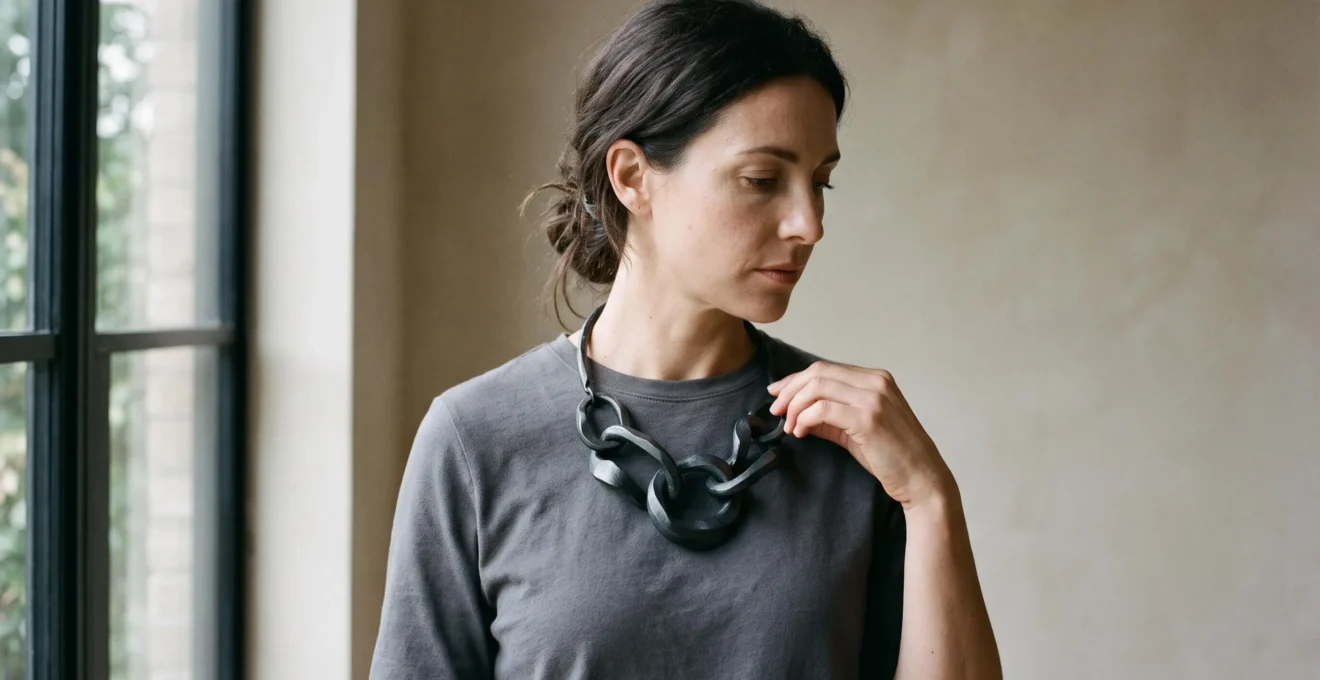
A sculptural necklace can transform a plain outfit into something distinctive, but its dramatic shape can also make getting dressed unexpectedly difficult. A necklace that looks elegant on a jewelry stand may seem oversized, theatrical, or oddly disconnected once you put it on.
The solution is rarely to hide the necklace or reserve it for formal occasions. Instead, give the necklace one clear visual role and let the rest of the outfit support it. A structured top, a compatible neckline, restrained secondary accessories, and an appropriate level of formality can make even an architectural statement piece feel wearable.
Whether your necklace features oversized metallic curves, abstract shapes, sculptural links, or a dramatic pendant, the same principle applies: visual impact needs a deliberate frame. Once you understand how proportions, textures, clothing, and other jewelry interact, you can style a bold piece without feeling as though you are wearing a costume.
How to make a sculptural necklace look intentional
- Choose a quiet, preferably structured outfit base and give the necklace a clearly defined area around the neckline.
- Match the necklace’s length and shape to your neckline, then keep competing accessories visually restrained.
- Adjust the styling to the occasion rather than assuming dramatic jewelry belongs only at formal events.
- Why Does a Sculptural Necklace Look Chic on Display but Overpowering Once You Put It On?
- How to Style a Sculptural Necklace Using 3 Anchors So It Looks Intentional in Daylight
- Which Neckline Works Best With a Sculptural Necklace: Crew, V-Neck, or Strapless for Balance?
- The Statement-Stacking Mistake That Makes a Sculptural Necklace Look Chaotic in Photos
- When Should You Wear a Sculptural Necklace to Feel Bold Without Feeling Overdressed?
- How to Layer 3 Fine Chains Using a 2-Inch Spacing Rule So They Stop Tangling
- How to Build a Ring Stack Using One Hero Ring and 2 Spacers So It Looks Clean
- How Can You Stack Thin Rings Without Looking Cluttered or Feeling Uncomfortable All Day?
Why Does a Sculptural Necklace Look Chic on Display but Overpowering Once You Put It On?
A sculptural necklace can appear elegant on display yet overwhelming when worn because its scale is suddenly judged against your face, neck, shoulders, and clothing. A jewelry stand presents the piece as an independent object; your body introduces proportions and competing visual elements. The difference is usually a styling challenge, not evidence that the necklace is unsuitable.
On a display bust, the necklace occupies a carefully controlled space. Nothing distracts from its curves, dimensions, or construction. Once worn, however, the necklace becomes part of a larger composition that includes your neckline, shoulder width, hair, clothing texture, and overall silhouette.
Visual weight is not the same as physical size. A dense, matte metal collar may look more substantial than an equally wide openwork design because it presents a more continuous surface. A polished piece may catch highlights that emphasize particular edges, while a dark finish can form a striking contrast against pale fabric.
These are visual tendencies rather than universal rules. Lighting, background color, surface finish, and individual design all influence the result.
Another common problem is the outfit making too many statements simultaneously. Consider a hypothetical combination of an oversized abstract necklace, a graphic patterned blouse, dramatic sleeves, and a saturated handbag. Each element can be attractive independently, but together they may compete for attention.
The practical correction is to simplify the surrounding outfit, not automatically replace the necklace with something smaller.
Lighting also matters. Product photographs often use controlled directional lighting to define every curve, while ordinary daylight produces a different balance of shadows and reflections. A piece may therefore look unexpectedly strong outside the display environment.
Before deciding that a necklace was a mistake, try it over a plain, solid-colored top near a window. Evaluate its proportions in a full-length mirror rather than focusing only on a close-up of the jewelry.
Once the issue becomes one of framing rather than taste, styling choices become much more manageable. Three simple anchors can create that frame.
How to Style a Sculptural Necklace Using 3 Anchors So It Looks Intentional in Daylight
To style a sculptural necklace intentionally, use three anchors: a quiet structured base, one subtle visual echo, and a clear area around the neckline. These choices give a dramatic piece context without making the outfit look overly coordinated. Test the finished combination in natural daylight to check whether the necklace remains the dominant focal point.
Anchor 1: Start with a neutral, structured base.
A plain crew-neck top, substantial cotton shirt, fine but stable knit, or simple structured dress gives the necklace a predictable background.
Fabric behavior matters. A heavy necklace resting on very fluid silk may pull the material into folds, while a firmer fabric can help preserve a clean silhouette. This depends on the necklace’s weight, construction, and fastening, so test the actual combination rather than relying on fabric labels alone.
Black, cream, charcoal, navy, and other solid colors are useful starting points because they reduce visual competition. Color is not forbidden; a saturated monochromatic outfit can work beautifully when its silhouette remains simple.
Anchor 2: Repeat one design element elsewhere.
Choose one recognizable feature of the necklace and echo it subtly. For example, repeat a brushed silver finish through a bag clasp, pick up a rounded shape in a small earring, or complement a vintage-inspired necklace with a similarly restrained accessory.
The echo should be recognizable without becoming a second statement. Matching every accessory precisely can make the outfit feel overly planned.
Anchor 3: Keep the neckline territory clear.
Give the piece enough visual breathing room. Remove an unnecessary scarf, avoid a competing necklace, or adjust a collar that interrupts the shape.
This does not mean every neckline must be completely bare. It means that overlapping elements should appear deliberate.
For a quick test, photograph your outfit in natural daylight from approximately arm’s length, with enough of your upper body visible to assess proportions. Ask what draws attention first. If several unrelated elements compete, remove or simplify one supporting detail.
Your five-step sculptural necklace outfit check
- Put on one solid-colored, stable-fabric top. Confirm that the fabric lies smoothly beneath the necklace.
- Position the necklace where it sits comfortably and naturally. Check in the mirror that its main shape is fully visible.
- Add one subtle echo through hardware, a small earring, or another accessory. Identify the single feature being repeated.
- Remove competing jewelry or adjust distracting clothing details. Confirm that the necklace remains the main focal point.
- Take one natural-light photograph and review it at normal viewing size. Keep the image as a reference for an outfit you can repeat.
With the supporting outfit established, the next decision is more precise: choosing a neckline that complements the necklace’s geometry.
Which Neckline Works Best With a Sculptural Necklace: Crew, V-Neck, or Strapless for Balance?
The best neckline depends on where your sculptural necklace sits and how its shape relates to the clothing. Crew necks often suit high, compact pieces; V-necks provide a natural frame for longer or pointed designs; and strapless styles offer an uninterrupted background for dramatic jewelry. None is universally superior, because necklace proportions and placement matter more than the neckline label.
Think of a neckline as a frame around artwork. Its shape either reinforces the jewelry’s design or introduces a competing line.
A useful comparison is to look at the necklace’s lowest point, its widest section, and the amount of space between the metal and the fabric.
| Neckline | Usually works well with | What to check |
|---|---|---|
| Crew neck | Compact collars, short sculptural chains, and rounded architectural pieces | Whether the necklace rests cleanly against or above the fabric without an awkward gap |
| V-neck | Elongated pendants, angular designs, and pieces with a defined lowest point | Whether the necklace follows the V without colliding with its edges |
| Strapless | Statement collars, broad sculptural forms, and designs intended to stand alone | Whether the necklace feels proportionate against the exposed shoulders and upper chest |
The most useful rule is to examine where the necklace ends. A short metal collar can look polished against a crew neckline when its lower edge follows the garment’s boundary. A pendant that falls into the center of a V-neck can reinforce the downward shape and create an uninterrupted visual line.
Problems arise when fabric and jewelry intersect awkwardly. A pendant that repeatedly catches on a neckline or disappears into a garment opening can look less intentional than the same pendant repositioned slightly higher or lower.
Collars, lapels, and hoods add another dimension. They create their own shapes around the neck, which may compete with a sculptural piece.
Try a collared shirt with the collar open, folded neatly, or positioned beneath the necklace. An oversized shirt can become a useful structured foundation when the fabric remains controlled around the jewelry.
There is no absolute prohibition against combining an elaborate collar and a statement necklace. In Vogue’s embellished-collar styling demonstration, Sarah Brown deliberately combines an embellished collar with a substantial Lanvin necklace, using texture to create an individual look.
That example illustrates a creative possibility rather than a rule that every elaborate collar will work with every necklace.
Strapless clothing creates the opposite challenge: very little garment structure surrounds the jewelry. A broad metal collar can look striking, but its volume becomes especially prominent against exposed skin.
If the result feels theatrical, try a more open sculptural design, shorten the necklace if its construction allows, or add understated earrings to provide subtle balance. Small earrings can complement the necklace without competing for attention.
The right neckline gives the jewelry a coherent outline. The same idea of visual hierarchy becomes even more important when other statement accessories enter the outfit.
The Statement-Stacking Mistake That Makes a Sculptural Necklace Look Chaotic in Photos
The most common statement-stacking mistake is giving several bold accessories equal visual importance. A sculptural necklace, oversized earrings, chunky rings, and an attention-grabbing bag can compete instead of creating a coherent outfit. For a cleaner photographed look, choose one principal accessory and make the remaining elements visibly quieter or connect them through a consistent design theme.
Imagine a hypothetical outfit containing a heavy silver necklace, large gold chandelier earrings, several colorful cocktail rings, and a prominently embellished handbag. Each accessory introduces another shape, material, and point of attention.
The necklace may no longer register as an interesting sculptural object because the viewer has no obvious place to begin.
Use a focal-point hierarchy rather than counting accessories. Decide which item deserves attention first, then assess whether the others support or challenge it.
A practical starting point is to keep secondary accessories at approximately half the perceived visual impact of the hero piece. This is a subjective styling comparison, not a measurable or scientifically validated ratio.
For example, a broad sculptural necklace might be paired with small silver studs, one understated ring, and a plain leather bag. The accessories still form a complete outfit, but they do not compete on equal terms.
In Vogue’s guide to layering jewelry, Laia Garcia-Furtado discusses concentrating attention on selected jewelry areas rather than treating every category as equally prominent. The article also acknowledges that successful combinations depend on personal preference rather than a universal accessory limit.
Photographs add another variable. Lighting, exposure, lens choice, camera distance, and framing can change how prominent reflective jewelry appears. Highly polished surfaces may catch bright highlights, while close camera angles can alter the perceived relationship between jewelry and the body.
These effects are not identical across lenses or lighting conditions. The reliable practical method is to photograph the intended outfit under conditions similar to those in which it will be seen.
If you are dressing for a photographed event, examine the full composition instead of zooming in only on the necklace.
Intentional maximalism can also work. The distinction is coherence: several pieces may feel connected when they share a metal finish, geometric language, period influence, or repeated motif.
A necklace with rounded silver forms, coordinating circular earrings, and a sculptural cuff may create a deliberate maximalist composition, even though all three pieces are prominent.
The goal is not mandatory minimalism. It is ensuring that each accessory contributes to the same visual idea.
With a clear focal-point hierarchy, the necklace can adapt to more occasions than its dramatic appearance might initially suggest.
When Should You Wear a Sculptural Necklace to Feel Bold Without Feeling Overdressed?
You can wear a sculptural necklace at work, over casual weekend clothes, to dinner, or at a formal event when its styling matches the setting. Feeling overdressed often comes from a mismatch between the necklace’s dramatic appearance and the rest of the outfit, rather than from the jewelry itself. Adjust the clothing and supporting accessories to make the overall level of effort feel deliberate.
A bold necklace does not automatically require a special occasion. Pairing it with straightforward everyday clothing can make the statement feel more relaxed.
Conversely, a formal event may provide an excellent setting for dramatic jewelry, particularly when the outfit follows the dress code and gives the necklace enough visual space.
The key question is not whether the necklace is too bold, but whether the full outfit makes sense in its environment.
Jewelry designers interviewed in The Zoe Report’s advice on statement jewelry recommend adapting statement pieces to personal style and occasion. Alison Chemla also describes pairing a prominent necklace with studs or small huggie earrings instead of equally dramatic earrings.
The following examples are practical styling suggestions, not fixed dress-code standards.
| Occasion | Suggested outfit | Balance adjustment |
|---|---|---|
| Everyday office | Plain knit, tailored trousers, understated shoes | Choose a manageable necklace scale and consider workplace expectations |
| Creative workplace | Structured shirt, relaxed tailoring, architectural necklace | Experiment with shape while keeping other accessories coherent |
| Casual weekend | Denim, simple sweater, flat shoes | Let relaxed clothing soften the necklace’s formality |
| Dinner or evening gathering | Minimal dark dress or monochromatic separates | Use the jewelry as the primary decorative detail |
| Ceremony or formal event | Refined dress or tailored ensemble appropriate to the dress code | Coordinate the necklace’s scale with the neckline and other formal elements |
For an ordinary daytime setting, denim and knitwear can be particularly effective. Their familiar textures contrast with the necklace’s artistic shape, allowing the piece to look expressive without making the entire outfit formal.
If you arrive somewhere and feel more dressed up than expected, you do not necessarily need to remove the necklace.
Try taking off statement earrings, adjusting an open shirt around the necklace, or shortening an adjustable piece so it sits more like a compact collar. Only adjust its length if the fastening and design safely allow it.
The change can be small because the necklace is not the only element determining how formal the outfit appears.
There is also an emotional dimension to wearing dramatic jewelry. A sculptural necklace attracts attention by design, and that can feel uncomfortable when you are not accustomed to wearing it.
Rather than trying to eliminate attention altogether, decide what you want to emphasize. One deliberate focal point gives the outfit a visual identity, while familiar everyday clothing can help you feel comfortable wearing it.
Of course, bold jewelry is only one option. On days when you want a quieter effect, fine chains provide an alternative that requires its own approach to proportion and wearability.
How to Layer 3 Fine Chains Using a 2-Inch Spacing Rule So They Stop Tangling
To layer three fine chains with fewer overlaps, start with necklaces separated by approximately 2 inches in length, then adjust their placement according to your neck, chain weights, and pendant shapes. Different lengths help establish separate visual levels, but spacing alone cannot guarantee that chains will not tangle. Clasp position, movement, and how each chain hangs also matter.
Fine-chain layering offers an alternative to a single sculptural statement necklace. Instead of concentrating impact in one large form, it creates visual interest through several smaller details.
The challenge is that thin chains move during ordinary activities. Turning your head, adjusting your clothing, or reaching into a bag can shift one strand over another.
Unequal chain weights, pendants, link designs, and the position of clasps can influence how the strands settle. Lightweight necklaces may shift more noticeably when combined with a heavier pendant chain.
Use the 2-inch spacing rule as a starting experiment, not a guarantee.
For example, a hypothetical arrangement could use:
- A 16-inch chain sitting relatively high around the neck.
- An 18-inch chain forming the middle layer.
- A 20-inch chain carrying a small pendant or serving as the lowest visual point.
These are example lengths rather than universal recommendations. The same chains may sit differently depending on neck circumference, body proportions, pendant weight, and necklace construction.
A comfortable first layer is more important than forcing a particular numerical arrangement.
Once the lengths look balanced, experiment with clasp positions. Keeping every clasp in exactly the same location may encourage hardware to gather in one area as the necklaces move.
Try positioning clasps toward different parts of the neck where the design allows, then assess whether the chains remain comfortable and properly aligned.
Varying chain weights can also change how each necklace hangs, although there is no reliable universal formula showing that alternating particular weights or clasp positions will prevent tangling.
Test the combination while walking, sitting, and turning your head. If two chains repeatedly knot together, separate their lengths further or replace the lighter one with a different design.
Adding a necklace separator is another possible choice, but it introduces additional hardware and may not resolve every combination.
Before returning layered necklaces to storage, separate the individual strands. Proper storage matters because chains and delicate jewelry can become scratched or damaged when kept carelessly together.
Fine chains also need not accompany a sculptural necklace. Removing the layers entirely can be the cleanest option when you want the larger piece to dominate.
This distinction between a visually interesting arrangement and a physically comfortable one also matters when styling rings.
How to Build a Ring Stack Using One Hero Ring and 2 Spacers So It Looks Clean
Build a clean ring stack by choosing one distinctive hero ring and surrounding it with two simpler bands that support its design. The hero provides the focal point, while the spacers establish rhythm without adding competing details. Adjust the number, width, and placement of the bands to suit your hand and comfort rather than treating the arrangement as a fixed formula.
The same visual principle that makes a sculptural necklace work can be applied to a much smaller area: one standout element supported by quieter pieces.
Begin with the ring you most want to highlight. It might feature a bold geometric shape, an oversized stone, a striking texture, or an unusual metal construction.
Next, select two slim complementary bands. Plain polished rings are a straightforward choice, while subtly textured bands can introduce detail without taking over.
A useful starting combination might include a sculptural silver ring between two narrow silver bands. Alternatively, a smooth gold hero ring could be paired with one polished gold spacer and one gently textured band.
Mixed metals can work too. The deciding factor is whether their relationship looks deliberate rather than whether every ring has precisely the same finish.
Avoid choosing spacers with large stones, strong protrusions, or complicated silhouettes if your goal is a restrained stack. Those details can turn the supporting rings into additional focal points.
Consider the total width of the stack in relation to your hand. A broad group of rings can occupy a substantial portion of the visible finger, particularly when the hero ring has a tall or wide design.
Longer fingers may accommodate more overall width without the stack feeling crowded, while shorter fingers may benefit from narrower bands or wider spacing between rings.
These are visual considerations, not rules about which hand shapes should wear particular jewelry.
Comfort is equally important. Ring bands can touch and move against each other as your fingers bend. Some combinations may also catch on clothing or place pressure against neighboring fingers.
Try gripping a coffee cup, turning a doorknob, and holding a steering wheel while stationary. If the rings pinch, shift uncomfortably, or interfere with your grip, modify the arrangement.
Remove a spacer, reduce the combined width, or distribute the rings over more than one finger.
Materials deserve attention as well. The Gemological Institute of America advises protecting jewelry from scratching, unsuitable storage, and exposure to potentially damaging substances in GIA’s jewelry-care recommendations.
That guidance supports careful handling, but it does not establish a specific safe combination of stacked metals, finishes, or ring profiles. Delicate plating, gemstones, and treated surfaces may require individual care.
Once the basic stack is comfortable, the same approach can be extended across several fingers without creating visual clutter.
Key takeaways before building a full ring combination
- Assess the relationship between rings, not simply how many you are wearing; coordinated shapes and finishes can make a fuller arrangement feel calmer.
- Leave enough space for natural finger movement, especially when rings have raised settings or substantial profiles.
- Keep visual balance and physical comfort as separate checks: a combination must work both in the mirror and during everyday tasks.
How Can You Stack Thin Rings Without Looking Cluttered or Feeling Uncomfortable All Day?
To stack thin rings without clutter or discomfort, coordinate their visual language, distribute them thoughtfully across your fingers, and check how they feel during normal movement. Several slim rings can look cleaner than a smaller collection of mismatched statement pieces. Comfortable band shapes, appropriate sizing, and sufficient space between raised details are just as important as appearance.
Thin rings provide many styling possibilities because they occupy less visual space individually. But a large number of delicate bands can still create a busy effect when their colors, textures, and shapes compete.
The key distinction is between coverage and clutter.
Coverage describes how much of the hand is decorated. Clutter describes how difficult it is to understand the visual relationship between the pieces.
For example, several slim rings in a consistent silver finish may create a relatively calm look across both hands. Three rings with dramatically different stone heights, contrasting finishes, and unrelated shapes may look busier even though fewer pieces are involved.
This is a styling preference rather than an objective measurement. Mixed metals, irregular shapes, and asymmetry can all look intentional when they contribute to a recognizable design.
Distribution can help. Instead of crowding every ring onto the same finger, place a few across neighboring fingers or split the arrangement between both hands.
Try one visual focal point per hand, or choose a more prominent stack on one hand and a simpler arrangement on the other.
When selecting rings for all-day wear, examine the inside and edges of each band. Smooth, rounded profiles may feel more comfortable for some wearers than sharp or angular edges, especially when several rings sit close together.
Fit also matters. Fingers can change in size throughout the day because of temperature, activity, and other individual factors. Rather than automatically sizing every stacking ring up, check that each ring fits securely without constriction under the conditions in which you plan to wear it.
A ring that becomes painful, causes numbness, or is difficult to remove is not suitable for continued wear in that condition.
Raised settings and textured surfaces can snag fabric or rub against nearby jewelry. Pay attention to these details when dressing, working, or handling delicate materials.
Remove rings when appropriate for sleeping, washing, cleaning, or activities that could expose them to impact or unsuitable chemicals, taking their particular materials and care instructions into account.
At the end of the day, store delicate pieces separately where needed to reduce accidental contact and scratching. Different gemstones, coatings, and metals may require different storage arrangements.
The most useful styling principle extends beyond rings: whether you are wearing a dramatic necklace, three delicate chains, or several slim bands, decide where you want attention to go and let the other pieces support that decision.
For your next outfit, choose one piece of jewelry you genuinely want to wear, build a quiet supporting look around it, and check both its visual balance and comfort. A sculptural necklace does not need a special occasion to feel right; it needs a setting that makes its presence deliberate.
Can you wear a sculptural necklace if you have a short neck?
Yes. Consider how much of the neck the piece occupies and where its lowest point falls. An open sculptural design or a slightly longer necklace may create more visible space than a rigid, high collar. There is no universal prohibition based on neck length; comfort, proportions, and personal preference are more useful criteria.
Can you mix gold and silver with a statement necklace?
Yes. Mixed metals can create an intentional look, particularly when one finish remains dominant or a common shape links the accessories. You do not need to match every item precisely. Keeping the secondary pieces relatively simple can help a sculptural necklace maintain its focal-point role.
Should your earrings match a large sculptural necklace?
Not necessarily. Small studs, huggies, or understated earrings can complement a large necklace without competing with it. A subtle relationship in metal finish, shape, or texture is often sufficient. Coordinated statement earrings are also possible when the overall styling deliberately embraces a more maximalist look.
Can you wear a statement necklace over a sweater?
Yes. A plain sweater can provide an effective background for sculptural jewelry, especially when its neckline and fabric allow the piece to sit naturally. Check whether the necklace catches on the knit, distorts the fabric, or moves excessively. Smoother, more stable knits may be easier to style with substantial pieces.
What if a sculptural necklace feels too heavy to wear comfortably?
First, check its fit, fastening, and position to see whether an intended adjustment improves comfort. A necklace that causes pain, persistent pressure, or skin irritation should not be worn simply to complete an outfit. Consider a lighter construction, a different design, or professional advice about suitable adjustments instead of prioritizing appearance over comfort.