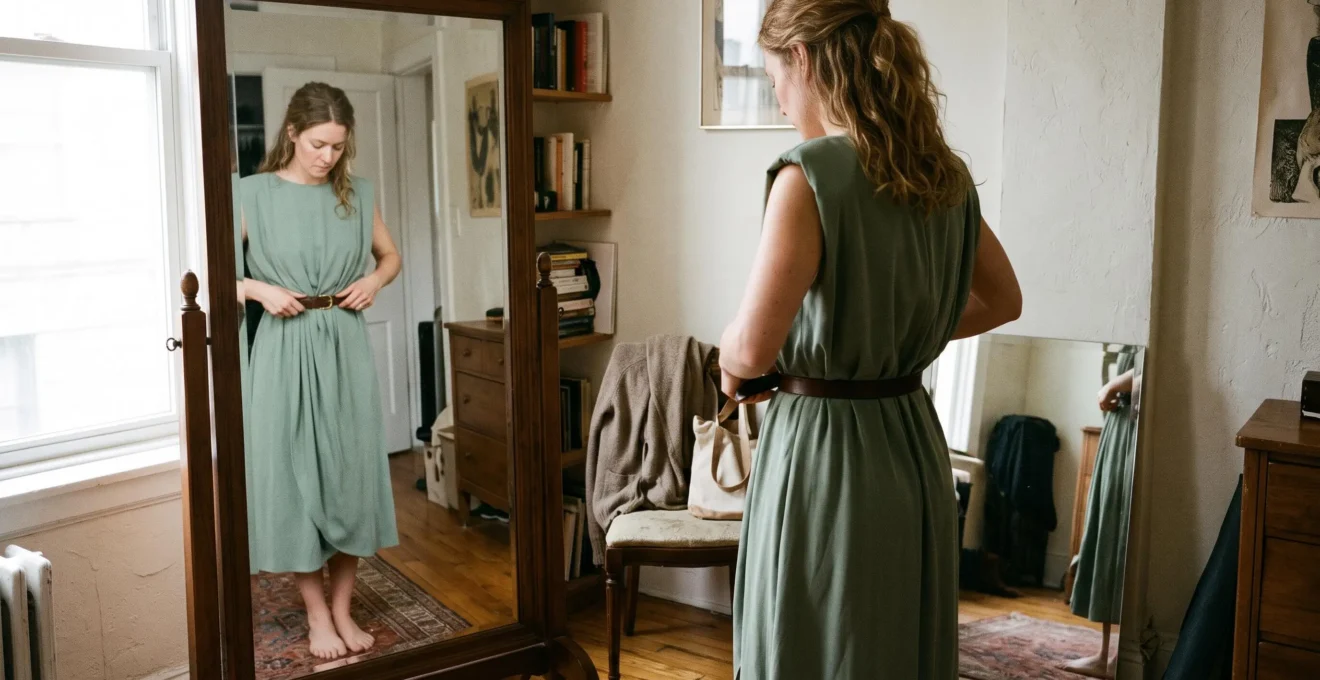
Fluid drapery can make an outfit feel comfortable, graceful, and easy to move in. Yet a beautifully draped dress or pair of wide-leg trousers can look completely different once you sit down, add a jacket, or see yourself from the side. The challenge is rarely having too much fabric. It is knowing where that fabric should move and where the outfit needs a visible point of definition.
The simplest approach is to give fluid clothing one intentional structural anchor. A defined shoulder, shaped neckline, partial tuck, or controlled hem can provide enough visual clarity without restricting movement. You do not need a small waist, fitted clothing, or a particular body shape to make this work.
Fabric weight, cut, layering, and the demands of your day also matter. A dress that looks balanced while standing may behave differently through several hours of sitting. Understanding those changes makes it easier to choose draped clothes that remain comfortable and visually intentional at work, during travel, and at events.
Fluid Drapery: The Essentials
- Keep one visible anchor, such as defined shoulders, a controlled neckline, or a deliberate waist detail, while allowing the remaining fabric to move freely.
- Check your outfit from the front, side, and back, then sit and stand before deciding whether the drape works.
- Choose cuts and fabrics according to movement, friction, light, and maintenance—not softness or price alone.
- Why Do Drapey Clothes Sometimes Look Sloppy Even When They’re Expensive ?
- How to Add One Structure Point to a Draped Outfit So You Keep Movement Without Losing Shape ?
- Which Is Easier to Wear All Day: Bias Cut, Pleats, or a Wrap Shape When You Sit a Lot ?
- The Double-Drape Mistake That Makes Your Outfit Lose All Definition by Midday
- When Should You Choose Drapery Over Structure to Stay Comfortable at a 4-Hour Event ?
- Which Is Easier to Wear Daily: Silk Satin, Silk Crepe, or Charmeuse When You Sit a Lot ?
- How to Build a Clean Vertical Line in an Outfit Without Wearing All Black or Tight Clothes ?
- How Can You Wear Smooth Silk Without Cling, Static, or “See-Through” Surprises Under Bright Light ?
Why Do Drapey Clothes Sometimes Look Sloppy Even When They’re Expensive ?
Expensive draped clothes can look shapeless because price does not determine how fabric hangs on the body. Fabric weight, bending resistance, garment construction, and the position of seams all influence the result. When material falls from the shoulders or bust without an intentional change in direction, it may create an uninterrupted block of volume rather than recognizable, designed folds.
Consider two dresses with similarly generous cuts. One uses a medium-weight fabric that forms controlled folds around its seams. The other uses material that falls almost straight from the shoulders, creating little distinction between the upper body and hem. Neither is inherently inferior, but the second may not produce the defined appearance you want.
This is partly a textile-engineering question. The scientific study of silk-fabric drapability in Fashion and Textiles identifies bending properties and other physical characteristics as important factors in how tested silk fabrics drape. It does not establish universal styling rules, but it explains why visual softness alone cannot predict how a finished garment will hang.
To evaluate a draped piece, use a three-angle mirror check. Stand naturally, then turn three-quarters toward the mirror and examine the back. Look for the original design lines: a defined shoulder, diagonal fold, shaped seam, or controlled change in volume. A front view alone may conceal fabric gathering behind the hips or hanging away from the upper back.
Next, distinguish intentional drapery from accidental volume. A cowl neckline, asymmetric fold, or deliberately generous sleeve has an identifiable design purpose. Several loose layers collecting in the same area may obscure those details instead.
Ask three practical questions: Where does the fabric begin to fall? Which feature directs its movement? Can you still recognize that feature from the side?
A garment does not have to outline your body to be successful. It simply needs to behave in a way that matches the appearance and movement you want.
Once you understand where excess volume comes from, the next step is to introduce one structural reference without sacrificing the fabric’s natural movement.
How to Add One Structure Point to a Draped Outfit So You Keep Movement Without Losing Shape ?
Add one structure point by choosing a single place where the outfit has a clear edge, shape, or change in volume. That point might be the shoulders, neckline, waist, cuffs, or lower half. With one visible anchor, the surrounding fabric can remain loose and mobile without the entire outfit appearing undefined.
Think of the approach as the single-anchor method. Instead of controlling every part of an outfit, identify the area that best supports the garment’s intended line.
- Shoulder anchor: Choose a clean shoulder seam or lightly structured jacket over a flowing dress.
- Neckline anchor: Use a defined V-neck, boat neck, or simple collar to establish the upper outline.
- Waist anchor: Try a partial tuck, adjustable tie, or softly gathered seam without tightening the entire garment.
- Lower-body anchor: Combine a flowing blouse with straight-cut trousers or a skirt that holds its shape.
A useful styling illustration is the 90/10 rule: imagine approximately 90% visual fluidity and 10% definition. This is a creative guideline, not a scientifically measured clothing proportion. It encourages small interventions rather than replacing movement with stiffness.
For example, a loose blouse and flowing trousers may only need the blouse tucked slightly at the front. Alternatively, rolling the sleeves to reveal the wrists can give a voluminous upper layer a more deliberate finish.
Choose the anchor according to fit preferences rather than treating body-shape categories as restrictions. Someone who enjoys highlighting a naturally defined waist may prefer a soft belt. Someone with a straighter torso or a fuller middle may find shoulder definition, an open neckline, or more controlled trousers comfortable and visually effective.
Your Five-Step Drapery Fit Check
- Put on the complete outfit and identify its most visible design feature. Record one feature you want to preserve.
- Choose one structural anchor and name its location: shoulders, neckline, waist, or lower half.
- Adjust that anchor without restricting movement. Confirm that you can raise both arms comfortably.
- Examine the front, side, and back in a mirror. Take three reference photos if helpful.
- Sit, stand, and walk several steps. Keep the adjustment only if the anchor remains visible and comfortable.
The goal is not to create the same silhouette on everyone. It is to find the smallest effective adjustment for the clothing and the person wearing it.
After establishing a dependable anchor, consider whether the garment’s cut can maintain that balance during a normal working day.
Which Is Easier to Wear All Day: Bias Cut, Pleats, or a Wrap Shape When You Sit a Lot ?
For frequent sitting, well-constructed pleats are often a practical starting point because they provide a recognizable line without requiring a fitted silhouette. Bias-cut clothes offer flexible, body-responsive drape but may shift or cling, while wrap garments allow adjustment yet can require checking for movement and coverage. The easiest option depends on fabric, fit, and construction.
These three designs distribute fullness differently. A bias cut places woven fabric diagonally across the body, allowing more give than a comparable straight-grain cut. Pleats organize excess material into folds. Wrap garments overlap sections of fabric, usually secured by ties, fastenings, or an internal closure.
That construction becomes relevant when you repeatedly transition between standing and sitting.
| Consideration | Bias cut | Pleats | Wrap shape |
|---|---|---|---|
| While seated | Follows body movement but may pull across certain areas | Folds open to accommodate sitting | Overlap moves and may need checking |
| After standing | May need the hem or side seams smoothed | May develop temporary fold or seat marks | Ties and overlap may need repositioning |
| Useful construction detail | Adequate ease and stable seam construction | Well-set pleats and suitable fabric recovery | Secure closure and sufficient overlap |
| Everyday maintenance | Depends on fabric and distortion | Depends on crease retention | Depends on fastening security |
The position of tension matters. With a bias-cut skirt, diagonal grain movement can create pulling around the hips or side seams if the garment lacks sufficient ease. Pleats allow some fullness to expand toward the front while seated. A wrap can accommodate changing posture, provided its overlap and closure remain secure.
However, front tension is not automatically preferable to side tension. A tight waistband, poorly placed pleat, or insufficient wrap overlap can make any of these cuts uncomfortable.
For long desk sessions, consider a pleated skirt with a comfortable waistband and fabric that retains its folds. For a day combining walking and sitting, a properly fitted bias-cut skirt can offer fluid movement. A wrap dress may work particularly well when its adjustable fastening lets you adapt the fit without repeatedly retightening it.
Run a seated test before purchase: sit normally, lean forward, cross and uncross your legs if that reflects your routine, then stand. Check for excessive riding, twisting, gaps, and pressure. Repeat after several minutes if possible.
Even the most comfortable cut can lose its intended outline when paired with another unrestricted layer, making the interaction between garments the next important consideration.
The Double-Drape Mistake That Makes Your Outfit Lose All Definition by Midday
The double-drape mistake happens when two flowing garments overlap without a contrasting edge, shape, or texture. A loose tunic over very fluid trousers, for example, can create continuous volume from shoulder to ankle. As the layers shift during movement, their individual design lines become harder to distinguish, leaving the outfit less visually organized.
This is not a rule against loose-on-loose dressing. Two flowing pieces can work beautifully together. The problem is uncontrolled overlap, especially where the hem of one garment obscures the shape or fastening of another.
Imagine a soft, long cardigan over a draped blouse and generous wide-leg trousers. Each garment may have attractive folds on its own, yet the combined outfit lacks a clear transition between its layers. By the afternoon, the cardigan may have shifted, the blouse may have untucked, and the trouser fabric may have developed creases.
Some fabrics also experience deformation or relaxation under their own weight or during wear. However, the amount varies with fiber, weave, construction, humidity, and loading. There is no reliable general rule that every fluid garment stretches by several centimeters during a normal day.
Research into woven-fabric behavior supports considering material mechanics rather than assuming identical outcomes. In the 1976 textile study on drape coefficients and fabric mechanical properties, researchers examined 138 woven-fabric samples and related drape behavior to mechanical characteristics. Those measurements do not directly predict how a particular layered outfit will look after hours of wear.
The styling solution is to build a contrast that does not depend on tightness.
- Pair a draped blouse with fluid-looking trousers made from fabric that has enough body to hold a clean crease.
- Wear a flowing cardigan over a top with a well-defined neckline or straight hem.
- Use a substantial waistband, visible seam, or controlled cuff as a subtle boundary between layers.
- Contrast a soft knit with matte poplin, lightweight gabardine, or another material that holds its surface differently.
Before leaving home, observe whether both garments collapse into the same folds when you sit. If so, try changing only one piece or adding one structural detail.
The same principle applies to longer occasions, where the right balance also depends on time spent sitting, temperature, lighting, and movement.
When Should You Choose Drapery Over Structure to Stay Comfortable at a 4-Hour Event ?
Choose drapery over rigid structure for a four-hour event when unrestricted sitting, standing, temperature changes, or varied movement matter more than maintaining a sharply tailored outline. Fluid garments can accommodate these activities comfortably, provided their closures, hems, and key design lines remain stable. Structured clothing remains useful when a precise silhouette is essential and the fit allows comfortable movement.
The most effective choice depends on the event rather than the assumption that either loose or tailored clothing is always more comfortable.
For a seated dinner or conference, prioritize waist comfort, sufficient room through the hips, and fabric that does not require constant smoothing. A draped skirt with controlled pleats or a softly shaped dress may be easier to manage than a restrictive fitted garment.
For a standing reception, stability at the shoulders and neckline becomes more important. A fluid dress with a secure shoulder line can allow movement while preserving its shape. For an occasion involving dancing or frequent walking, check that hems, closures, and draped panels do not interfere with your steps.
Temperature and lighting change the decision. In a warm room, a lightweight garment with sufficient ease may feel more comfortable than close-fitting tailoring, although fiber composition and airflow remain important. In a cool venue, soft layering can work well if the additional layer does not disrupt the original drape.
Natural daylight and directional event lighting can reveal fabric texture, wrinkles, and underlayers differently. A structured garment may display sitting creases prominently, while a softly folded fabric can integrate some wrinkles into its existing design. Conversely, thin draped fabric may reveal underlayers under bright backlighting.
For photographs, examine the outfit from seated and standing positions. A garment that photographs beautifully while standing may bunch at the waist or expose an awkward opening when seated.
A practical hypothetical choice illustrates the trade-off: for a four-hour networking dinner with extended sitting and occasional standing, a draped midi dress with a defined neckline and comfortable waist may offer a better balance than a tightly tailored dress. At a formal ceremony where a sharply defined silhouette is preferred, comfortable tailoring may be equally appropriate.
Comfort is not simply how a garment feels during the first fitting. It includes how often you must adjust it and whether its construction supports the movements you expect to make.
Fabric choice becomes especially important when that outfit includes silk, whose surface, weight, and construction can substantially change the wearing experience.
Which Is Easier to Wear Daily: Silk Satin, Silk Crepe, or Charmeuse When You Sit a Lot ?
Silk crepe is often a convenient starting point for daily wear because its textured, typically less reflective surface can make small wrinkles and changes in drape less visually prominent. Silk satin creates a smoother, shinier appearance, while charmeuse offers a particularly fluid satin-style finish. Actual comfort and durability depend on fabric weight, weave, finishing, garment construction, and care requirements.
There is an important terminology distinction: satin describes a weave, while charmeuse is a fabric construction commonly associated with a satin face and a less lustrous reverse. These are not completely separate fiber categories. Crepe likewise describes a family of fabrics with characteristic textures and constructions, rather than a single standardized material.
That means silk satin and silk charmeuse can overlap in their properties, and comparing their names alone will not reliably identify which garment is easier to wear.
| Factor | Silk satin | Silk crepe | Silk charmeuse |
|---|---|---|---|
| Typical appearance | Smooth, often glossy | Textured, commonly matte | Fluid with a lustrous face |
| Visible creasing | Reflections may emphasize creases | Texture may disguise minor creases | Smooth surface may reveal folds |
| Sitting and movement | Depends on weight and fit | Depends on crepe construction and fit | Fluid drape may shift over underlayers |
| Wear considerations | Evaluate snagging and surface marks | Evaluate texture and abrasion behavior | Evaluate friction and surface durability |
For example, a heavier charmeuse may feel more substantial and provide more coverage than a very lightweight crepe. Conversely, a lightweight crepe can offer exceptional fluidity. Neither the weave name nor the sheen guarantees that fabric will remain comfortable and visually consistent after prolonged sitting.
Weight deserves particular attention. Silk fabric specifications sometimes use momme, a traditional measure of fabric weight, while other listings use grams per square meter. Comparing weights on the same basis is more informative than treating a fabric label as a guarantee of opacity, strength, or quality.
Maintenance also matters. The University of Georgia Cooperative Extension‘s textile-fiber reference describes silk as absorbent and moderately wrinkle-resistant while identifying sunlight, perspiration, and high temperatures among potential sources of damage.
For daily office or travel wear, examine the actual garment’s lining, seams, weight, and care label. Consider whether its maintenance requirements fit your routine. A beautiful silk garment that needs frequent specialist care may be less practical than another construction you can maintain consistently.
Once the fabric is suitable, the next styling decision is how to guide the eye through the outfit without relying on dark colors or body-hugging shapes.
How to Build a Clean Vertical Line in an Outfit Without Wearing All Black or Tight Clothes ?
Build a clean vertical line by keeping the outfit’s main shapes visually connected from neckline to hem. Similar colors, aligned garment openings, and controlled changes in fabric volume can create that continuity without fitted clothing or an all-black palette. The effect depends on the overall arrangement of garments rather than a universal rule about which colors make a body look longer.
There are two useful approaches to visual definition. A hard line relies on sharp tailoring, strong contrast, or a tightly controlled outline. A soft vertical line uses color continuity, fabric direction, and gently defined reference points.
To create the softer version, use the three-point alignment method as a practical styling exercise:
- Neckline: Establish an intentional opening or clear upper edge, such as a V-neck or a softly structured collar.
- Waist or middle transition: Position a seam, partial tuck, or overlapping garment edge where it creates a readable change in the outfit.
- Hemline: Choose a hem that falls cleanly and does not interrupt the outfit with unplanned bunching.
These points do not have to follow a perfectly straight geometric line. They simply help the eye recognize an organized direction through clothing that still moves freely.
Color can reinforce the effect. Try cream trousers with an oatmeal blouse, a muted blue dress with a slightly darker blue outer layer, or olive trousers with a sage draped top. Closely related tones connect separate pieces while preserving visual interest.
A single contrasting accessory can then add definition without breaking the overall effect. For example, a narrow leather belt over a tonal dress provides a localized focal point, while shoes close in color to the trousers can preserve continuity at the lower edge.
Texture offers another option. A matte woven trouser can provide a clean boundary beneath a soft silk blouse. Alternatively, a fluid skirt and a lightly structured knit can share a similar color while remaining distinct through their surfaces.
Test the finished outfit from a few steps away. Notice whether the neckline, middle transition, and hem work together. If one garment hides every other edge, adjust its length, drape, or position before changing the entire outfit.
The same attention to fabric surfaces becomes essential with smooth silk, particularly when lighting and static change how a garment behaves against the body.
What to Remember Before Wearing Smooth Silk
- Evaluate static cling, transparency, and visible creasing separately; each has different causes and requires different checks.
- Test fabric coverage under lighting similar to the environment where you plan to wear the garment.
- Choose compatible underlayers and follow the garment’s care label before attempting any treatment to control cling.
How Can You Wear Smooth Silk Without Cling, Static, or “See-Through” Surprises Under Bright Light ?
Wear smooth silk more confidently by checking three separate issues before leaving home: static cling, transparency under strong light, and visible creasing. Reduce friction between incompatible layers, choose an appropriate lining or underlayer, and test the garment in realistic lighting. These precautions cannot guarantee perfect results, but they help identify problems before they become distracting.
Silk’s smooth surface can make changes in how it rests against the body especially noticeable. A fabric that falls freely in the fitting room may behave differently when worn over tights, synthetic underwear, or another garment during a dry day.
Static cling results from electrical charge building up through contact and friction. Transparency depends on factors such as fabric density, color, construction, and illumination. Wrinkles and pressure marks arise from mechanical deformation and fabric recovery. Treating all three as a single problem encourages ineffective solutions.
According to the FAO technical manual on silk’s physical and electrical properties, silk can accumulate static charge through friction, while higher humidity can help dissipate that charge. This establishes a material principle rather than a guaranteed fix for every finished silk garment.
For cling, examine the layers touching the silk. Certain synthetic undergarments, hosiery, or linings may increase friction and charge buildup, depending on the materials and conditions. A compatible natural-fiber underlayer or suitable lining may reduce the problem, but results vary. Avoid exposing delicate silk to unnecessary tumble drying or high heat, and do not apply unfamiliar anti-static products without checking fabric compatibility.
For transparency, use a backlighting test. Hold the fabric in front of a strong window or position a phone light behind a small section, without pressing a hot light source against the textile. This can reveal thin areas and differences in fabric density.
Then put the garment on with the underwear or slip you intend to wear. Examine it in front lighting and backlighting, ideally with another person checking coverage from a respectful distance if you prefer. Fabric that appears opaque against skin in soft room light may reveal underlayer contrasts when a bright light shines through it.
Choose underwear based on how its color and seams appear beneath the specific garment. Skin-adjacent tones can sometimes be less conspicuous than bright white, but the appropriate choice depends on your skin tone, the garment’s color, and lighting. A carefully selected slip or lining can provide additional coverage without relying on color matching alone.
Finally, check the fabric after sitting. Smooth silk can display fold lines or pressure creases, but the extent depends on the construction and finish. Inspect the lap and hip areas before choosing whether to steam or otherwise treat the garment, always following the care instructions.
Before your next outing, wear the complete outfit under realistic lighting, sit and stand, and make one adjustment at a time. Prioritize the drape you enjoy, the coverage you want, and the comfort you can maintain throughout the day.
Can a loose dress look intentional without a belt?
Yes. A clear shoulder line, defined neckline, shaped seam, or controlled hem can provide enough visual organization without waist emphasis. Choose the detail that complements the garment’s cut and feels comfortable rather than automatically adding a belt.
Should a draped garment touch the body or hang away from it?
Either can work. Some designs use fabric that follows the body’s contours, while others deliberately create space. The useful test is whether the intended folds and garment edges remain recognizable during movement, without unwanted pulling, twisting, or restrictions.
How can you tell whether a fluid fabric will keep its appearance after sitting?
Try the garment in seated and standing positions, checking crease visibility, seam distortion, and the position of its hem. The result depends on textile construction, fabric weight, fit, and finishing. A short fitting-room test provides useful information but cannot fully predict all-day performance.
Will adding a slip always prevent silk from clinging?
No. A slip may improve coverage and help fabric move more freely, but its own fiber composition and interaction with the silk can influence static buildup. Test the combination in the conditions you expect to encounter and choose a compatible underlayer rather than assuming every slip has an anti-static effect.
Is heavier fabric always better for creating controlled drapery?
No. Weight interacts with bending resistance, weave, construction, and garment design. Some heavier fabrics form stable folds, while others hang straight or pull downward at their support points. Lighter fabrics may create excellent movement when their cut and construction are appropriate. Evaluate the finished garment rather than relying on weight alone.