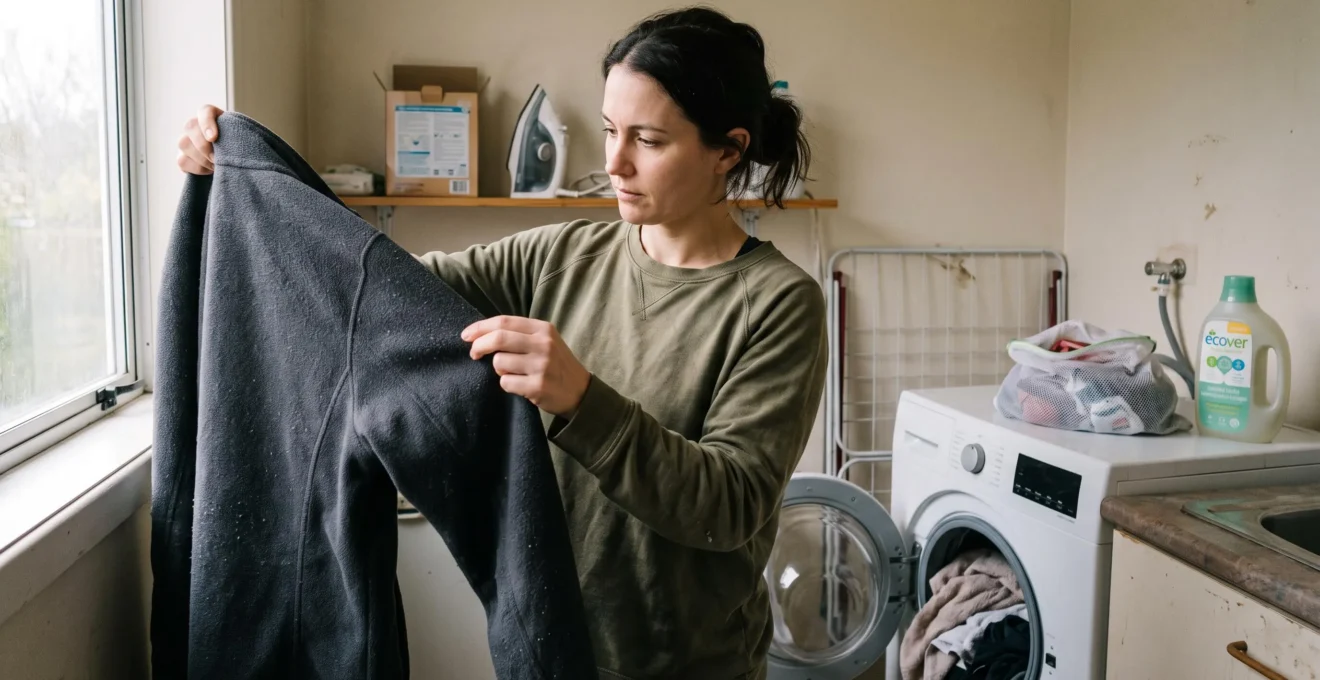
Recycled polyester and recycled nylon can be sensible choices for clothing that needs to be lightweight, quick-drying and resistant to repeated use. But the word “recycled” tells you remarkably little about how comfortable a garment will feel, whether it will develop pills or how long it will stay in your wardrobe.
A recycled polyester running top and a recycled polyester everyday jumper may behave very differently. The first can perform well because it moves moisture through a carefully designed fabric and dries quickly. The second might develop visible surface wear where a bag strap rubs against it. Neither outcome is determined by recycled content alone.
The most useful buying decision starts with the garment’s purpose, then considers fabric construction, care requirements, environmental trade-offs and expected lifespan. Recycled fibres can reduce demand for virgin raw materials, but they remain synthetic where the underlying polymer is plastic. That distinction matters for microfibre pollution, comfort and end-of-life recycling.
Recycled fibres: the practical buying rules
- Choose recycled synthetics when fast drying, low weight and technical performance genuinely improve how you use the garment.
- Check fabric construction, friction points and care requirements: recycled content alone does not predict pilling, microfibre shedding or durability.
- Consider linen, lyocell, cotton or repairable outerwear when everyday comfort, repeated wearing and long-term maintenance matter more than drying speed.
- Why Can Recycled Polyester Still Shed Microfibres Even If It’s “Eco-Friendly”?
- How to Choose Recycled-Fibre Clothing by Use Case So It Doesn’t Pill or Snag Fast?
- Which Is Better for Outerwear in Wet Weather: Recycled Synthetics or Waxed Cotton Options?
- The Recycled-Content Percentage Trick That Sounds Impressive but Changes Little
- When Should You Prioritise Recycled Fibres for Travel or Sport to Reduce Washing and Drying Hassles?
- Which Works Better for Heat and Sweat: Linen, Tencel, or Recycled Polyester Blends?
- Which Is the Best Choice for Basics: Organic Cotton, Better Cotton, or Conventional at Half the Price?
- Is Organic Cotton Worth Paying 20% More for Basics You Wear Every Week?
Why Can Recycled Polyester Still Shed Microfibres Even If It’s “Eco-Friendly”?
Recycled polyester can release microplastic fibres because recycling does not change the fact that polyester is a plastic-based material. Washing, wearing and abrasion can detach tiny fragments from the fabric. However, recycled polyester is not automatically more prone to shedding than virgin polyester: yarn construction, surface finishes and fabric structure can matter more than recycled origin.
Polyester is commonly made from polyethylene terephthalate (PET). When recovered PET is processed into textile fibres, the resulting material retains the physical characteristics of a synthetic polymer. Mechanical recycling can affect polymer quality through processing and repeated heat exposure, but it is inaccurate to assume that every recycling method automatically produces shorter textile fibres that break more easily.
A 2024 experimental comparison involving four pairs of commercially available virgin and mechanically recycled polyester textiles found no statistically significant difference in the number of fibres released. Fabric structure and treatments influenced the results. The 2024 study comparing microfibre release from virgin and recycled polyester therefore challenges the simple assumption that recycled polyester always sheds more.
Two different kinds of damage are often confused:
- Microfibre shedding involves tiny fragments separating from textiles during washing, abrasion or wearing. Synthetic fragments can become environmental microplastics.
- Visible pilling occurs when loose or broken fibres become entangled into small balls on the fabric surface. Pills may remain attached or eventually detach.
A garment can shed particles without obvious pilling, and a badly pilled garment does not necessarily release more particles into wastewater than every smoother alternative.
The European Environment Agency assessment of textile microplastics identifies laundering and everyday wear as sources of emissions, with substantial release possible during the first washes.
200,000–500,000 tonnes
Estimated annual quantity of textile-derived microplastics entering the global marine environment, according to research estimates summarised by the European Environment Agency in 2022. This is not a measurement specifically of recycled polyester or a current directly observed annual total.
European Environment Agency, 2022.
Reducing washing-related emissions involves using cooler, shorter suitable cycles, avoiding unnecessarily abrasive detergent formulations and limiting excessive agitation. A liquid detergent may help in some circumstances compared with a more abrasive powder. A suitable laundry bag can contain some released fibres, depending on its design, but an ordinary mesh delicates bag should not be assumed to filter microplastics effectively. Avoid both overloading the drum and washing very small loads unnecessarily.
Polyester-cotton blends introduce another complication: they can release synthetic and natural fibres, while separating the different fibre types for recycling remains technically difficult and commercially limited. Natural-fibre shedding is not equivalent to plastic pollution, but it is still material loss.
Recycled content addresses where raw material comes from; careful textile design and maintenance address what happens during use. Both deserve attention when buying garments intended to last.
How to Choose Recycled-Fibre Clothing by Use Case So It Doesn’t Pill or Snag Fast?
Choose recycled-fibre clothing according to the friction, stretching and washing it will experience. Dense woven jackets and technical trousers can be sensible recycled-synthetic purchases, while loosely knitted tops and heavily rubbed surfaces deserve closer inspection. The quality of the yarn, fabric construction and finishing is more informative than the recycled percentage alone.
A recycled nylon windbreaker faces different mechanical stresses from a soft recycled polyester cardigan. Tight weaves can help restrain surface fibres, while brushed fleeces and open knits expose more fibres to abrasion. Snagging is particularly relevant when exposed loops catch on jewellery, rough surfaces or backpack hardware.
Use the garment’s everyday role as the starting point:
| Garment or use | Potential advantage | What to check |
|---|---|---|
| Lightweight jackets and windbreakers | Low weight, fast drying and compact storage | Weave density, abrasion zones and seam quality |
| Daily knitwear | Warmth or softness depending on construction | Surface fuzz, yarn stability and rubbing points |
| Sports tops and leggings | Stretch recovery and moisture-management potential | Fabric recovery, stitching and surface abrasion |
| Underwear and frequently washed basics | Quick drying and easy laundering | Elastic recovery, softness and repeated-wash performance |
| Bags and durable accessories | Abrasion resistance when appropriately constructed | Fabric weight, coating, reinforcement and hardware |
In a shop, pinch the cloth, examine the weave under good light and gently release a stretched section to see whether it returns to shape. Fabric weight, often expressed as grams per square metre (GSM), provides useful context but is not a standalone durability rating.
Elastane may improve fit and recovery, especially in sportswear. Its presence does not inherently weaken recycled fibres, although elastic components may age differently and make end-of-life material separation harder.
There is no universal rule that increasing recycled content in a fine fabric automatically increases pilling. Processing quality, yarn type and the final structure determine how exposed fibres behave. A tightly constructed fabric with high recycled content may outperform a poorly made virgin-fibre garment.
After purchase, inspect the fabric after the first three washes as an early quality check. Record whether the garment retains its fit, whether surface fuzz develops and whether seams twist. Three washes are not a scientifically established lifespan test, but early changes can reveal practical problems worth addressing while a return or quality complaint may still be possible.
Five checks before committing to a recycled-fibre garment
- Identify its main use and friction points. Write down whether it will face backpack straps, frequent sitting, stretching or repeated washing.
- Inspect the fabric in good light. Record whether it is tightly woven, loosely knitted, brushed or visibly fuzzy.
- Read the complete composition and care label. Note the recycled-fibre percentage, elastane content and washing requirements.
- Ask for product-specific durability evidence, such as pilling or abrasion test information. Record the test or note that no result was provided.
- Keep a short care record after the first three washes. Check shape, surface condition and seams against their original appearance.
A well-made garment that survives regular friction and laundering is generally a more useful purchase than a superficially impressive recycled-content claim attached to fragile clothing.
Which Is Better for Outerwear in Wet Weather: Recycled Synthetics or Waxed Cotton Options?
Recycled synthetic shells are usually the more practical choice for lightweight, packable rainwear, especially when constructed with an effective waterproof membrane and sealed seams. Waxed cotton suits people who prefer repairable, longer-kept jackets for everyday wear and intermittent rain. Neither fabric category guarantees waterproof performance without considering its construction and maintenance.
A tightly woven recycled polyester or nylon jacket may offer initial water resistance through a durable water-repellent treatment, commonly called DWR. That finish encourages droplets to bead and roll away, but water repellency is not the same as waterproofness.
For persistent rain, the membrane, coatings, seam sealing, closures and overall design determine how reliably the garment prevents water penetration. A jacket made from recycled polyester with an effective waterproof construction can outperform a much heavier cotton alternative during prolonged exposure.
Waxed cotton uses a fabric impregnated or coated with wax to resist water. It offers a distinctive feel and can often be maintained through cleaning, repairs and re-waxing. However, it can be heavier, less packable and less convenient when a soaked outer surface needs to dry quickly.
| Criterion | Recycled synthetic outerwear | Waxed cotton outerwear |
|---|---|---|
| Rain protection | Potentially waterproof with appropriate membrane and sealed seams | Water-resistant when properly waxed; varies by design |
| Weight and packing | Often lighter and easier to pack | Often heavier and bulkier |
| Breathability | Varies significantly with membrane, ventilation and design | Can feel less ventilated because of the wax treatment |
| Maintenance | Cleaning and periodic DWR restoration as needed | Spot cleaning and periodic re-waxing |
| Long-term repair | Possible, but laminate damage can complicate repairs | Often repairable through patches, stitching and re-waxing |
| End of life | Laminates, coatings and mixed components complicate recycling | Wax and other components also affect recycling and biodegradation |
Maintenance requirements are not fixed intervals. Some synthetic jackets retain useful water repellency through many outings, while others need restoration sooner because of heavy abrasion, dirt or washing. Likewise, waxed cotton may require attention when rain stops beading on exposed areas.
The environmental comparison is also more complicated than natural versus recycled. Using recycled synthetic feedstock can reduce demand for virgin plastic, but laminated jackets can be challenging to recycle again. Cotton is a cellulose-based fibre, yet wax coatings, dyes and garment components affect whether a finished jacket can biodegrade under real disposal conditions.
Some wax products are petroleum-derived, so a waxed cotton jacket should not automatically be described as entirely renewable or biodegradable. Nor should every recycled synthetic shell be considered environmentally superior without examining its useful lifespan.
For hiking and unpredictable wet-weather travel, a properly specified technical shell is often the stronger tool. For everyday commuting and a jacket you enjoy maintaining, waxed cotton may offer a more satisfying long-term relationship with the garment.
The Recycled-Content Percentage Trick That Sounds Impressive but Changes Little
A high recycled-content percentage confirms something about material sourcing, not necessarily about garment quality or overall environmental performance. A top containing 90% recycled polyester may still pill, retain odours or wear out quickly. The useful questions are whether the claim is independently verified, how the fabric performs and whether the garment will last.
Marketing language often blurs several different kinds of information. “Made with recycled materials” may refer to a specific component without making the recycled share of the entire product clear. “30% recycled polyester” is more specific, but shoppers still need to know whether the percentage applies to the whole garment, the main fabric or a particular component.
Certification offers another layer of assurance, although its scope must be understood precisely.
The Textile Exchange’s RCS and GRS certification standards provide third-party verification of recycled materials and supply-chain traceability. The Global Recycled Standard (GRS) also includes social, environmental and chemical-processing requirements.
Under the described GRS framework, consumer-facing GRS product labelling requires at least 50 % recycled content, while a lower 20% threshold applies in other certification contexts. These thresholds should not be confused. Textile Exchange has also announced a transition towards its Materials Matter Standard, so applicable certification requirements should be checked when reviewing a current product claim.
| Claim | What it can establish | What remains unknown |
|---|---|---|
| Made with recycled materials | Claims some recycled input | Exact proportion and independent verification |
| 30% recycled polyester | States a specific recycled share for the referenced material or component | Durability, origin verification and whole-product composition |
| RCS certified | Third-party recycled-content and chain-of-custody assurance within the standard’s scope | Garment lifespan or pilling resistance |
| GRS certified | Recycled-content traceability plus additional processing-related requirements | Overall lifecycle superiority or everyday performance |
The distinction matters when comparing two garments. A hypothetical 90%-recycled jumper replaced after a short period of wear is not automatically a better purchase than a durable 40%-recycled alternative used for years. A proper environmental comparison would also need production, laundering and end-of-life information, rather than assuming that longevity alone determines every impact.
There is a further circularity limitation. Recycled polyester often originates from PET bottles rather than discarded polyester clothing. This is commonly described as open-loop recycling, because material moves between product systems rather than repeatedly returning to the same textile application.
Textile-to-textile recycling exists, but dyes, blended fibres, coatings, elastane and collection infrastructure can complicate it. Buying recycled polyester therefore does not guarantee that the garment can be recycled into another garment after use.
The most informative label is one supported by verifiable material content, clear construction details and relevant durability evidence—not simply the largest recycled number on the swing tag.
When Should You Prioritise Recycled Fibres for Travel or Sport to Reduce Washing and Drying Hassles?
Prioritise recycled polyester or nylon for travel and sport when light weight, moisture transport, stretch or fast drying genuinely save time and effort. These qualities can make technical clothing easier to manage than absorbent cotton. However, synthetic garments may retain unpleasant odours, so faster drying does not automatically mean fewer washes.
A running top, lightweight travel trousers or packable rain shell can be an excellent use of recycled synthetic fibres. Their performance depends on fabric engineering rather than the recycled label: suitable yarns, knit structures and finishes allow moisture to spread or move away from the skin before evaporating.
Polyester itself absorbs very little moisture into its fibres, but a well-designed synthetic textile can wick liquid sweat through capillary action. This explains why a performance top may dry quickly after exercise even though polyester is not naturally absorbent.
Odour is the more complicated trade-off. Skin oils and odorant compounds can remain associated with polyester, and some wearers find their synthetic sportswear develops persistent smells despite regular laundering. Wash frequency therefore depends on activity intensity, fit, drying conditions and personal experience.
For travel, the simplest approach is to build a mixed-fibre wardrobe around garment function:
- Recycled synthetic base layers: useful for active days, exercise and situations where garments need to dry quickly after washing.
- Natural-fibre shirts and trousers: potentially comfortable for slower days, with wear between washes determined by odour, hygiene and conditions.
- Recycled synthetic outer layers: practical when weight, wind protection and packability are priorities.
- Repairable knitwear: useful for layering and repeat wear when rapid drying is less important.
A hypothetical packing comparison makes the distinction clearer. A traveller planning several days of strenuous walking might choose two quick-drying technical tops and alternate them, washing as necessary. Someone spending the same period in cafés and museums might prefer more comfortable everyday shirts that do not require washing after every use.
Neither wardrobe automatically produces fewer washes. The outcome depends on sweat, odour, weather and the actual care routine.
Also examine textile treatments. Some water-repellent finishes have historically used PFAS, while certain antimicrobial finishes use silver-based substances. Such treatments can raise environmental questions and should not be assumed necessary for ordinary clothing. A PFAS-free specification or an untreated fabric may be preferable when the finish offers little practical benefit.
Recycled technical fabrics are most convincing when they solve a real functional problem. Outside those situations, comfort and the ability to wear an item repeatedly may outweigh marginal packing or drying advantages.
Which Works Better for Heat and Sweat: Linen, Tencel, or Recycled Polyester Blends?
Linen is often a comfortable choice for hot, dry conditions, while TENCEL-branded lyocell can offer a soft, absorbent feel in warm everyday wear. Recycled polyester blends are useful during vigorous exercise when engineered moisture transport and rapid drying matter most. No fibre wins in every climate: fabric weight, weave, fit and airflow can matter as much as composition.
Three physical processes shape how clothing feels in warm conditions. Breathability describes how easily air or water vapour can move through a textile. Absorption describes how much liquid moisture a fibre takes up. Wicking describes movement of liquid moisture through a fabric structure.
These properties are related but not interchangeable. A highly absorbent fabric may initially feel comfortable but take longer to dry once saturated. A low-absorption synthetic fabric can transport sweat effectively when constructed to promote capillary movement.
Linen, made from flax, is valued for its moisture absorption, relatively crisp handle and ability to be woven into breathable lightweight clothing. Its tendency to crease is a normal characteristic rather than evidence of poor quality.
TENCEL is a brand used for specific cellulosic fibres, including lyocell. Lyocell can provide a smooth touch and substantial moisture absorption. Its production involves solvent recovery, although the environmental performance of any finished garment also depends on sourcing, manufacturing and processing.
Recycled polyester retains the basic moisture characteristics of polyester. It generally absorbs little moisture into the fibre, but a suitable performance construction can move liquid sweat across the fabric surface and facilitate drying.
| Situation | Practical starting point | Important limitation |
|---|---|---|
| Very hot, dry weather | Loose-fitting lightweight linen | Creases and can feel damp after heavy sweating |
| Humid weather, moderate activity | Lightweight lyocell with good airflow | Absorbed moisture may take time to dry |
| Intensive sport | Engineered recycled polyester-rich performance fabric | Odour retention and synthetic microfibre release |
| Warm-weather commuting | Linen, lyocell or a comfortable lightweight blend | Fit and fabric construction may outweigh fibre type |
Not every polyester blend will feel hotter than every linen or lyocell garment. A loose, thin synthetic fabric may ventilate better than a thick, tightly woven natural-fibre garment. Likewise, adding polyester to linen or lyocell may improve drying or shape retention depending on the fabric, while changing its tactile comfort.
When choosing summer clothing, hold the material up to the light, assess its weight and consider how freely it sits around the body. For sportswear, look for a fabric specifically designed to manage perspiration rather than assuming that recycled content delivers wicking performance.
Once the garment’s heat and sweat requirements are clear, the next decision is whether its material sourcing and expected lifespan justify its price—especially for basics that get worn every week.
Which Is the Best Choice for Basics: Organic Cotton, Better Cotton, or Conventional at Half the Price?
Organic cotton is a reasonable choice when verified farming practices matter to you, while Better Cotton supports a different agricultural improvement framework. Conventional cotton can offer good value if the garment is well constructed and lasts. For frequently worn basics, compare certification and manufacturing quality separately: none of these sourcing categories guarantees longer-lasting seams, better shape retention or less shrinkage.
Organic cotton certification concerns how the cotton is grown and verified through the relevant production and supply chain requirements. Organic agricultural standards restrict synthetic pesticides and fertilisers and prohibit genetically modified seed under applicable rules. However, an organic-fibre claim should not be confused with certification of the entire finished garment’s chemical processing or labour conditions.
Better Cotton follows a different model. The Better Cotton Initiative Principles and Criteria address farm-level environmental, social and economic requirements, including crop protection, natural resources, fibre quality and working conditions.
Unlike organic cultivation, the Better Cotton framework does not universally prohibit synthetic pesticides. It promotes improved practices, restrictions on hazardous inputs and continuous improvement. A Better Cotton sourcing claim also needs careful interpretation because supply-chain models do not always imply that the physical cotton in a particular garment can be identified as certified cotton.
Conventional cotton does not provide the same sourcing assurance merely through its fibre description. That does not mean every conventionally grown cotton garment is poorly made or that every organic cotton garment is durable.
| Option | What it primarily addresses | What to inspect separately |
|---|---|---|
| Certified organic cotton | Verified organic cotton cultivation and applicable supply-chain requirements | Fabric density, construction and shrinkage |
| Better Cotton | Specified farm-level sustainability practices and improvement requirements | Exact claim scope, garment quality and durability |
| Conventional cotton | No particular sustainability certification implied by the term | Construction, longevity, sourcing transparency and price |
For a T-shirt worn every week, examine whether the neckline is well stabilised, the side seams hang straight and the fabric feels substantial enough for its intended use. Long-staple cotton can support yarn quality, but the term alone does not prove the resulting garment will last longer.
A heavier fabric is not always better either. A dense summer T-shirt may survive abrasion well but feel uncomfortable in hot weather. Construction quality should be assessed alongside comfort, not instead of it.
Think about a hypothetical comparison between an inexpensive conventional cotton T-shirt and a more expensive organic cotton version. If both have comparable construction and wear similarly, the cheaper garment may deliver lower cost per wear. If the more expensive version is demonstrably better constructed and lasts much longer, the calculation can change.
Neither outcome can be established from the label alone. Certification provides evidence about particular production practices, not a garment-wide durability test.
With those distinctions in mind, a modest price premium for organic cotton becomes a budget decision rather than an automatic measure of environmental value.
Key takeaways before paying a premium
- Separate the value of a verified farming standard from the quality of the finished garment; certification is not a durability guarantee.
- Compare the likely number of wears and the care requirements before judging whether a more expensive basic offers better value.
- Spend selectively on frequently worn pieces when the sourcing information and actual garment construction both justify the difference.
Is Organic Cotton Worth Paying 20% More for Basics You Wear Every Week?
Paying 20% more for certified organic cotton can be worthwhile when the farming standard matters to you and the garment meets your comfort and durability needs. It is not automatically a financial or environmental win. The strongest comparison considers verified sourcing, construction quality and cost per wear rather than relying on a premium percentage.
For a T-shirt worn every week, cost per wear offers a useful way to compare long-term value:
Cost per wear = purchase price ÷ number of wears before the garment is retired.
Consider an explicitly hypothetical example. A conventional T-shirt costs £20 and is worn 50 times before replacement. Its purchase cost per wear is £0.40. A comparable organic cotton T-shirt costs £24, exactly 20% more, and is worn 80 times. Its purchase cost per wear is £0.30.
In that scenario, the organic shirt delivers better purchase-price value. But if both garments are worn 50 times, the organic version costs £0.48 per wear and the conventional version remains at £0.40. The example demonstrates how lifespan changes the calculation; it does not establish that organic garments generally last longer.
Costs associated with washing, drying, repairs and disposal are excluded from this simplified example. A full environmental assessment would also require more than purchase-price arithmetic.
The organic premium primarily pays for a product whose cotton sourcing meets specified agricultural requirements, alongside whatever other differences exist in brand pricing, production and construction. Organic practices can reduce reliance on certain synthetic agricultural inputs, but claims of universally lower water consumption are not justified without accounting for location, irrigation, yields and farming conditions.
Price premiums also vary across brands and product ranges. A 20% difference is a scenario, not a fixed market rule, and a higher retail price does not prove superior fibre quality or stronger stitching.
For budget planning, prioritise the purchases where the added cost buys something you can verify. Frequently worn T-shirts and underwear are sensible places to consider certified organic cotton because those are recurring purchases with sustained fabric-to-skin contact. Organic certification, however, is not itself evidence that the finished textile is safer against the skin or free from all processing chemicals.
For outer layers worn less frequently, a well-made conventional or Better Cotton garment may offer reasonable value, especially if it can be kept and repaired over time. The decision should depend on personal sourcing priorities and actual garment quality rather than a rigid rule that one fibre category belongs in every wardrobe.
For your next basics purchase, compare two garments side by side: check their verified sourcing claims, inspect the fabric and seams, review care requirements and estimate realistic use. Choose the one that best balances those factors within your budget, and keep wearing what you already own while it remains serviceable.
Is recycled polyester actually better for the environment than virgin polyester?
Recycled polyester can reduce demand for virgin petroleum-derived raw materials, but the full environmental comparison depends on feedstock, recycling technology, energy use, garment lifespan and disposal. It remains a synthetic material capable of releasing microplastics. A recycled-content claim alone is not enough to demonstrate lower overall environmental impact.
Can a recycled polyester garment be recycled again after use?
Sometimes, but access to textile-to-textile recycling remains limited. Blends, dyes, elastane, coatings and garment components complicate sorting and processing. Check the availability of a genuine textile recycling scheme rather than assuming a garment is recyclable simply because it contains recycled polyester.
Does recycled nylon behave differently from recycled polyester?
Yes. Nylon and polyester are different polymer families, with distinct moisture absorption, mechanical and thermal characteristics. Both can be recycled and used in technical clothing. However, their everyday performance still depends heavily on yarn construction, fabric finishing and the garment’s intended use. Neither recycled category automatically guarantees abrasion resistance or longevity.
Should recycled synthetic clothing be washed less often to reduce microplastics?
Avoiding unnecessary washing can reduce some laundering-related wear and particle release, but hygiene and garment care remain important. Air out garments when appropriate, spot-clean minor marks and wash when needed using suitable cooler, shorter cycles. Recycled synthetic fabrics can also shed particles during wearing, so less frequent washing does not eliminate microfibre pollution.
Is a 100% recycled polyester garment always better than a blended fabric?
No. A single-polymer textile may be easier to process through some recycling routes than a mixed-fibre textile, but that does not guarantee collection or recyclability. A blend may deliver better comfort, elasticity or practical wear performance. Compare construction, lifespan, use case and the actual end-of-life options before treating recycled percentage as a ranking.