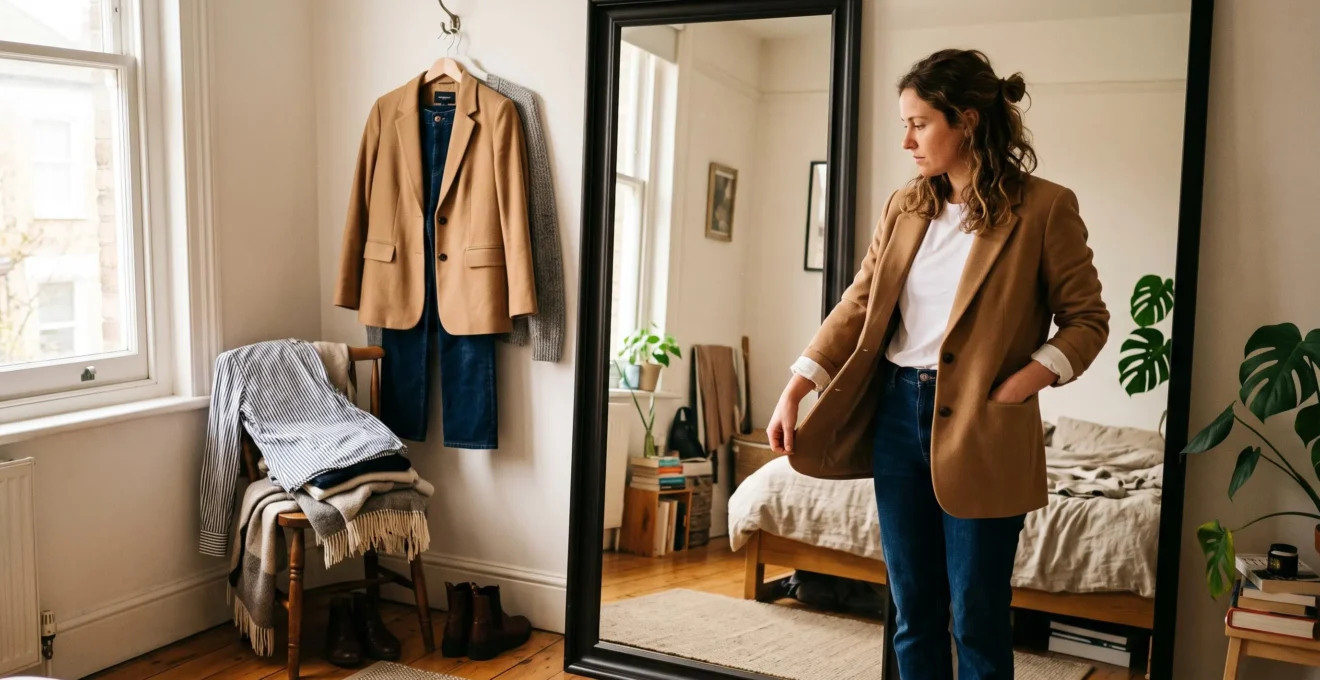
If one tailored blazer needs to work for office days, casual dinners, weekends and everything between, start with its construction rather than its colour. A softly structured, single-breasted blazer in a versatile neutral is usually the safest choice. It should have enough room for a fine knit, shoulders that move comfortably and fabric that still looks good after sitting down.
The goal is not to make a formal suit jacket behave like casual clothing. It is to choose a blazer that already belongs in both settings. That distinction affects everything from lapel shape and lining to what you can wear underneath.
Thirty outfits are possible as a wardrobe-planning exercise, not a guarantee attached to any particular jacket. Five tops, three bottoms and two shoe choices create 30 theoretical combinations. The useful question is how many of those combinations actually look coherent, suit your lifestyle and feel comfortable enough to repeat.
The one-blazer buying strategy
- Choose adaptable construction: soft shoulders, moderate lapels and a single-breasted closure give you more ways to wear the blazer.
- Fit for movement and layering: reject uncomfortable shoulders and chest restriction before considering alterations.
- Build outfits through contrast: change the top, trousers, shoes and texture rather than keeping every formal element together.
- Why Does One Blazer Look Modern While Another Looks “Office-Only” Even in the Same Colour?
- How to Check Blazer Fit in 5 Steps So You Don’t Waste Money on “Almost Right” Tailoring?
- Which Is More Versatile: a Single-Breasted or Double-Breasted Blazer for a 3-Day Office Week?
- The Blazer Styling Mistake That Makes You Look Overdressed at a Casual Dinner
- When Should You Choose Wool, Cotton, or Linen Blazers So You Don’t Overheat or Look Creased?
- How to Check Jacket Structure in 90 Seconds So You Don’t Buy a Blazer That Collapses
- How to Add One Streetwear Piece to a Smart Outfit Without Losing Credibility at Dinner
- How Can You Wear Streetwear as an Adult Without Looking Like You’re Trying Too Hard?
Why Does One Blazer Look Modern While Another Looks “Office-Only” Even in the Same Colour?
Two blazers in the same colour can communicate completely different levels of formality because of their construction, proportions and fabric finish. A jacket with pronounced shoulder padding, a rigid chest and crisp lapels resembles conventional business tailoring. A softer jacket with natural shoulders, comfortable ease and a more relaxed drape integrates more easily with denim, knitwear and casual shoes.
Consider two navy blazers. One has strongly defined shoulders, a smooth worsted finish, a fitted waist and a sharply controlled lapel. The other has lighter internal construction, a subtly textured fabric and a shoulder that follows the body’s natural line. Both can look polished, but the second has fewer visual features that demand matching formal trousers.
This distinction is grounded in actual tailoring construction. Proper Cloth‘s explanation of jacket construction describes how canvas, shoulder padding and sleeve-head support influence a jacket’s shape, drape and formality. The manufacturer also distinguishes soft construction from structured construction, including within jackets that use canvas.
Soft shoulders are not necessarily the same as an entirely unstructured jacket. A jacket can have little shoulder padding but still contain chest canvas that keeps its front relatively rigid. Conversely, a softly constructed half-canvassed blazer can retain shape while allowing a more relaxed shoulder line.
Try a simple mirror exercise before buying. Wear the blazer over a plain T-shirt, leave it open and casually push up the sleeves if the design allows. Then look at the full outfit rather than the jacket in isolation.
- Does the shoulder follow your body, or does it create an exaggerated formal outline?
- Does the lapel fall naturally when the jacket is open?
- Does the chest remain comfortable without a button holding the front together?
- Does the blazer look intentional with jeans, or does it resemble a separated suit jacket?
This is a styling judgement, not a scientifically validated construction test. It is useful because it reproduces the casual outfits the jacket will need to support.
An oversized cut is not automatically a more modern one. Extra fabric around the body combined with rigid lapels, heavy padding and a formal button position can create an oversized business silhouette rather than a relaxed outfit. Proportion and structure still have to work together.
Once the construction looks appropriate, the next priority is fit. A beautifully relaxed jacket is still a poor investment if it restricts movement or cannot accommodate your normal layers.
How to Check Blazer Fit in 5 Steps So You Don’t Waste Money on “Almost Right” Tailoring?
Check a blazer while moving, not just while standing in front of a mirror. Reach forward, cross your arms, sit down, lift your arms and bring them around your body. These movements reveal restriction across the shoulders, back, chest and sleeves. Prioritise a comfortable shoulder fit because major shoulder alterations are complicated and often uneconomical.
Start by wearing the type of top you expect to use most often. If the blazer is intended for both office shirts and weekend knitwear, test it with each. A jacket that fits perfectly over a thin T-shirt may feel too tight over a sweater.
The shoulder seam should generally sit close to the intended shoulder line, without excessive pulling or unsupported fabric collapsing beyond the sleeve head. Intentionally relaxed silhouettes can extend beyond the natural shoulder, but that extra width should look deliberate.
Proper Cloth’s jacket shoulder-fit reference identifies tension and pulling as potential signs of narrow shoulders, while excess width can produce wrinkles and sleeve-head dimpling. It also explains why shoulder alterations can involve several interconnected garment components.
Fit problems fall into two practical categories. Sleeve length and modest waist adjustments are common tailoring jobs. Shoulder reconstruction, significant sleeve-pitch correction and major length changes are more invasive. Some are technically possible, but their cost and effect on the original proportions can make them poor value.
Do not mistake a fitted appearance for a versatile fit. A blazer purchased with minimal chest ease may look sharply tailored when buttoned but feel restrictive over a roll-neck or thicker knit. For a multi-outfit wardrobe, comfortable layering matters more than achieving the narrowest possible silhouette.
Fabric behaviour matters too. Some knitted constructions and loosely woven fabrics can relax with use, while linen naturally develops creases. The degree of change depends on the particular fabric and construction, so avoid assuming every linen or knit-blend jacket will stretch. If purchasing secondhand, examine how the garment has already settled on its hanger and on the body.
Your five-movement blazer fitting checklist
- Reach forward: extend both arms as if typing or driving. Record whether the upper back pulls or prevents comfortable movement.
- Cross your arms: bring each hand towards the opposite shoulder. Note whether the sleeve heads or upper arms become restrictive.
- Sit down: unbutton the blazer and sit naturally. Check for uncomfortable bunching, excessive pulling and an awkward hem position.
- Raise your arms: lift both arms above shoulder height. Observe whether the jacket rides up severely or restricts the motion.
- Hug yourself: wrap your arms around your torso. Confirm that you can move comfortably and repeat the test with your intended knitwear layer.
A tailored jacket will not move like a sweatshirt. The goal is reasonable freedom of movement without substantial strain or a fit that becomes uncomfortable during ordinary activities.
If two sizes both look acceptable, test the larger one with your thickest intended layer before choosing. That decision may determine whether the blazer works across multiple seasons rather than with just one outfit.
Which Is More Versatile: a Single-Breasted or Double-Breasted Blazer for a 3-Day Office Week?
For most people working in an office three days a week, a single-breasted blazer is the more flexible first purchase. It looks natural open or buttoned, accommodates casual layering and transitions easily into weekend outfits. A double-breasted blazer offers a stronger tailored silhouette, particularly when closed, but its overlapping front and styling conventions make it less adaptable.
Think about the number of ways each blazer can be worn, not just whether one looks more fashionable. A single-breasted design can frame a T-shirt, fine knit or shirt while remaining open. It can also be buttoned for a presentation or worn under a coat without creating as much fabric overlap at the front.
A double-breasted blazer creates more visual emphasis around the chest and waist. Its overlapping panels and additional buttons can deliver a deliberate, polished outfit with relatively little styling. The trade-off is that the same design can feel conspicuously formal when paired with very casual clothes.
Traditional double-breasted tailoring is commonly worn fastened while standing and opened when seated for comfort. Contemporary relaxed styling sometimes breaks that convention, but an open double-breasted front may hang differently from a single-breasted one.
The following comparison is a practical styling guide, not a measured ranking of garment performance.
| Decision factor | Single-breasted | Double-breasted |
|---|---|---|
| Desk work and commuting | Easy to leave open and adjust while sitting | More front overlap to manage when sitting |
| Meetings and presentations | Polished without dominating the outfit | Strong, intentionally tailored appearance |
| Casual denim outfits | Generally easy to integrate | Needs careful balance of shape and fabric |
| Layering over knitwear | Often simpler, depending on fit | Requires particular attention to chest ease |
| First versatile purchase | Safer default choice | More specialised style preference |
For a three-day office week, use your schedule as a filter. If two days involve commuting, sitting at a desk or moving between informal appointments, single-breasted tailoring is usually the lower-maintenance choice. If your working days centre on presentations, client-facing meetings or more formal settings, a softly constructed double-breasted blazer may be appropriate.
Body proportion matters more than a trend forecast. On a shorter torso, a long double-breasted front can visually compress the lower body. On a fuller bust, overlapping panels may pull or distort if the jacket lacks adequate room. Neither feature makes double-breasted tailoring unsuitable; it makes trying different button positions, lengths and cuts essential.
For the 30-outfit objective, a softly structured single-breasted blazer with moderate lapels and neutral buttons usually offers the more forgiving foundation. A double-breasted version can be an excellent second blazer once you understand which silhouettes you wear repeatedly.
Whichever closure you choose, the blazer should still make sense when your working day ends. Dinner is often where an otherwise successful jacket starts to look unexpectedly corporate.
The Blazer Styling Mistake That Makes You Look Overdressed at a Casual Dinner
The mistake is rarely wearing a blazer to dinner. It is combining too many formal signals in one outfit: a sharply tailored jacket, pressed shirt, matching-weight trousers and polished leather shoes. Together, those details resemble business clothing even when every item is attractive individually. Keep the blazer, but relax the surrounding pieces to create a deliberate smart-casual balance.
A useful styling method is to treat formality as a limited budget. For an informal restaurant, allow one or two obviously tailored elements rather than making every item contribute the same message. The blazer can be the polished anchor while the remaining clothes make the outfit feel appropriate for the setting.
For example, imagine a charcoal blazer worn with crisp trousers, a white business shirt and polished loafers. To change the impression without replacing the jacket, switch to straight-leg dark denim, a fine-gauge crew-neck knit and clean suede shoes.
The overall outfit remains considered, but it no longer resembles something assembled for an office presentation.
Fabric weight and surface texture are equally important. A very smooth, crisp worsted jacket can contrast sharply with washed denim or textured casual knitwear. The pairing is not automatically wrong, but it requires more attention than combining those pieces with a softly constructed, textured wool or cotton blazer.
Consider three hypothetical dinner combinations built around the same dark navy blazer:
- Relaxed restaurant: off-white T-shirt, straight dark jeans and minimal leather sneakers.
- Smart-casual dinner: lightweight charcoal knit, taupe trousers and brown suede loafers.
- Dressier evening: soft-collar shirt, tailored black trousers and understated leather shoes.
The blazer stays constant. The level of formality changes because the other garments introduce different textures, shapes and footwear.
There is also a limit to dressing things down. Replacing every refined element with highly distressed jeans, bulky trainers and an oversized graphic hoodie can make the outfit look disconnected. A fine knit or casually open soft-collar shirt often creates a more convincing transition between tailoring and relaxed clothing.
Consider the restaurant itself. A neighbourhood bistro, a creative-industry dinner and a formal dining room have different expectations. The same outfit should not be treated as universally appropriate.
If the jacket remains too formal after changing the trousers and shoes, its cloth may be contributing to the problem. Choosing the right material can solve comfort and styling issues at the same time.
When Should You Choose Wool, Cotton, or Linen Blazers So You Don’t Overheat or Look Creased?
Choose wool when you want resilience and broad styling versatility, cotton when you prefer a more relaxed appearance, and linen when breathability and a naturally creased texture suit the occasion. The best material depends on fabric weight, lining and construction as much as season. An unlined lightweight wool blazer may feel more comfortable than a heavily lined summer jacket.
Wool is often dismissed as winter-only fabric, but that overlooks how much variation exists between different wool textiles. A lightweight woven wool blazer behaves differently from a heavy flannel jacket.
Woolmark‘s explanation of wool fibre properties describes wool’s natural elasticity, ability to absorb moisture vapour and capacity to recover after compression. Those fibre characteristics can support comfort and wrinkle resistance, although the performance of a finished blazer also depends on weave, fabric weight, finishing and construction.
Wool crepe and other softly textured wool fabrics are worth considering when you want a jacket that can accompany both tailoring and casual clothing. Inspect the actual garment rather than assuming every wool blazer will drape or resist creasing equally well.
Cotton usually offers a more informal visual character, especially in washed twill or other textured weaves. It can be particularly useful for everyday outfits involving denim, chinos and simple knitwear. However, tightly woven cotton may still feel substantial, and some cotton fabrics show creases prominently.
Linen has a distinctive texture that suits relaxed tailoring. It can feel comfortable in warm conditions, but its tendency to wrinkle means it often develops visible creases around elbows, the waist and seated areas. That lived-in appearance may be desirable at a casual dinner but less useful when a crisp presentation is expected.
The decision is easier when compared across common wearing situations.
| Consideration | Wool | Cotton | Linen |
|---|---|---|---|
| Office-to-dinner versatility | Strong option in a soft, lightweight construction | Good for relaxed or business-casual settings | Best where visible creasing is acceptable |
| Wrinkle behaviour | Often resilient, depending on fabric | Varies significantly by weave and finish | Commonly develops pronounced creases |
| Warm-weather suitability | Possible in lightweight, breathable designs | Depends on weight and weave | Often useful for relaxed warm-weather outfits |
| Visual character | Can range from crisp to softly textured | Generally approachable and casual | Textured and intentionally relaxed |
| Packing | Depends on jacket structure and fabric | Depends on construction and crease behaviour | Expect some creasing unless specially finished |
Before trusting a summer-fabric label, inspect the lining. Full lining can reduce airflow and change how warm a jacket feels. Sleeve lining, partial lining and completely unlined construction each offer different comfort and finishing trade-offs. The shell fabric alone cannot tell you how the complete garment will perform.
Try a simple fabric-scrunch comparison in a store, with permission. Gently compress a small, inconspicuous section of fabric for roughly 30 seconds, then release it. Compare how visibly different fabrics crease and recover. This is an informal screening exercise, not a validated prediction of how a finished blazer will look after an hour of wear.
For regular travel, also consider how the shoulders and chest respond to folding. A lightweight jacket designed for easy packing may tolerate a bag better than one with substantial internal shaping. Unlined does not automatically mean crease-proof, and structured wool is not universally unsuitable for travel.
Once the fabric makes sense for your routine, examine what lies beneath it. Internal construction affects not only how formal a blazer looks but how well it retains its intended shape.
How to Check Jacket Structure in 90 Seconds So You Don’t Buy a Blazer That Collapses
A quick structural inspection can reveal obvious problems before you buy a blazer. Feel the shoulder, examine the chest, turn back the lapel, inspect the sleeve head and check the lining, hem and buttons. These checks help identify stiffness, irregularities and weak finishing, but they cannot reliably establish every internal construction method or predict how long a jacket will last.
Start with the shoulder. Pinch the fabric gently around the seam and sleeve head to assess how much padding is present and whether the transition into the sleeve feels smooth. Look for visible lumps, uneven construction or a shoulder line that does not sit comfortably on your body.
Next, examine the chest and lapel. Some jackets use a floating canvas layer, while others rely on fusible interlinings bonded to the outer fabric. Half-canvassed construction generally supports the upper chest and lapel while leaving the lower front constructed differently.
The distinction matters because internal layers influence drape, shape and how the front responds to movement. However, a chest that feels firm does not automatically prove that a jacket is cheaply fused. Different canvases, fabrics and finishing methods can produce similar sensations.
Some fused jacket fronts can develop bubbling when the bond between layers deteriorates. Heat, moisture, cleaning conditions, adhesive quality and garment age can all be relevant. Visible bubbling or separation on a secondhand jacket is a reason for caution, but simply touching a new garment cannot establish whether that problem will occur.
For a useful 90-second inspection, divide your attention between five areas:
- Shoulders: check for excessive padding, uneven shape and irregular sleeve-head transitions.
- Chest: assess flexibility and look for existing ripples, bubbles or puckering.
- Lapels: observe whether they roll smoothly or appear distorted and uneven.
- Sleeve heads: check that the sleeves hang consistently without obvious twisting or unexplained tension.
- Hem, lining and buttons: look for clean finishing, secure attachments, intact seams and lining that does not pull against the outer fabric.
This is a practical shopping inspection rather than a substitute for professional garment assessment. If construction type is important to your purchase, ask the retailer or manufacturer for an explicit description.
A fully structured jacket is not inherently better or worse than a softly constructed one. Heavy structure can help maintain a sharply tailored appearance, while lighter construction can make the same category of garment easier to dress down. For a versatile first blazer, a soft or moderately structured design is often a sensible compromise.
Secondhand shoppers should place particular emphasis on existing wear: chest bubbling, damaged lining, loose buttons, distorted lapels and stains that cleaning may not remove. In lower-priced minimalist jackets, secure seams and sound finishing may matter more to the practical purchase decision than an impressive-sounding construction label.
Once the jacket passes these checks, versatility becomes a question of styling. One of the simplest ways to broaden its use is to introduce a carefully selected casual or streetwear element.
How to Add One Streetwear Piece to a Smart Outfit Without Losing Credibility at Dinner
Add one streetwear piece by replacing a conventional smart-casual element rather than stacking several casual trends on top of tailoring. Minimal sneakers can replace formal shoes, relaxed trousers can replace pressed trousers, or a simple hoodie can replace a knit. The contrast works best when the blazer has enough ease and the overall outfit maintains consistent proportions.
The key is controlled contrast. A tailored blazer already supplies visual structure. One informal element can make that structure look intentional rather than strictly business-oriented. When the outfit contains several oversized, heavily branded or visually dominant streetwear pieces, the blazer may stop looking like the anchor.
Begin with shoes because they change the mood of an outfit without altering the blazer’s fit. Clean, relatively low-profile sneakers are usually the easiest streetwear-influenced addition. They work particularly well with straight trousers, understated denim and a plain knit.
Cargo trousers require more care. Wide pockets and substantial fabric introduce volume below the waist, so a moderately relaxed blazer and a simple top may integrate better than a very short, tightly fitted formal jacket. The aim is to balance silhouettes rather than require every garment to be equally loose.
A hoodie creates the greatest layering challenge. Its hood, sleeve bulk and body volume take up space beneath the blazer. If you want that combination regularly, test it while shopping. A jacket that fits comfortably over a shirt may not accommodate hoodie sleeves without pulling across the shoulders or upper arms.
For a practical hierarchy of difficulty:
- Easiest: tailored blazer, plain T-shirt, dark trousers and clean low-profile sneakers.
- Moderate: softly constructed blazer, fine knit, relaxed cargo trousers and simple shoes.
- More demanding: roomy blazer, understated hoodie, straight trousers and minimal footwear.
Replacing a formal piece tends to be easier than adding another prominent garment. For example, swapping loafers for sneakers changes the outfit without altering its layering. Replacing an overcoat with a bomber jacket can also introduce streetwear influence, provided the bomber fits comfortably over the blazer and the combination suits the weather.
These combinations have limits. A creative office or casual restaurant may welcome the contrast, while a conservative client meeting or formal restaurant may call for less conspicuous casual styling. Check the expected level of dress before applying the same formula everywhere.
Footwear should also be proportionate to the trousers. Very bulky trainers with narrow tailored trousers can create an abrupt contrast that overwhelms the silhouette, even when the colours coordinate.
The principle extends beyond individual outfits. A considered wardrobe makes streetwear easier to wear at any adult age because versatility comes from proportion, quality and repetition rather than constant novelty.
Key takeaways before building your wardrobe
- Buy for the life you actually lead: a blazer that suits your most common activities is more valuable than one reserved for ideal occasions.
- Judge proportion across the entire outfit. Relaxed tailoring, modern denim and understated footwear should support rather than compete with each other.
- Prioritise pieces that can be worn repeatedly with existing clothes before buying additional statement items.
How Can You Wear Streetwear as an Adult Without Looking Like You’re Trying Too Hard?
Adult streetwear looks intentional when trend-driven pieces are limited, proportions are balanced and the rest of the outfit provides a stable foundation. Age is not the obstacle. Combining several oversized silhouettes, prominent logos and competing statement pieces can make an outfit feel overworked. One contemporary element paired with well-fitting, understated clothes usually creates a more adaptable result.
The most useful rule is one prominent trend per outfit. That does not mean you must wear conventional clothes forever. It means allowing one piece to lead while the others provide visual consistency.
For example, a softly tailored charcoal blazer, plain white T-shirt, straight-leg dark denim and minimal sneakers can feel current without depending on novelty. Change the T-shirt to a fine roll-neck and the sneakers to suede shoes, and the blazer becomes suitable for a different setting.
Visible branding is another useful filter. Large logos and collaboration-specific graphics can make a garment strongly associated with a particular trend or moment. They may suit your style, but they are less adaptable if your goal is to repeat the same pieces across professional and casual environments.
Unbranded garments are not automatically better made. Judge them by fit, fabric, construction, care requirements and whether they integrate with the clothes you already own.
Proportion is more important than age-based dressing rules. A relaxed blazer can work with wide-leg trousers, but consider defining the outfit through a neater top or more streamlined footwear. Likewise, an oversized hoodie may work better under a jacket specifically chosen to accommodate it rather than a narrow, sharply tailored blazer.
The one-blazer strategy can be translated into a concrete wardrobe exercise. Imagine owning the following compatible pieces:
- Five tops: white T-shirt, black T-shirt, fine crew-neck knit, soft-collar shirt and lightweight roll-neck.
- Three bottoms: straight dark jeans, relaxed neutral trousers and tailored dark trousers.
- Two footwear options: understated sneakers and suede loafers.
Five tops multiplied by three bottoms and two shoe options produces 30 theoretical combinations around the same blazer. That is a hypothetical wardrobe matrix, not evidence that every combination will suit every body, climate or dress code.
The real target is a set of outfits you would confidently wear. Some combinations may look better than others, and accessories, seasonal comfort or footwear requirements may reduce the practical number. The point is to test compatibility before buying more clothes.
Cost per wear adds another decision filter. As a hypothetical calculation, a blazer purchased for $300 and worn 100 times has a purchase-price cost per wear of $3. If worn only 15 times, that figure becomes $20. Cleaning, alterations and repairs would add to the true ownership cost.
A less expensive blazer that remains uncomfortable is not necessarily the better purchase. Equally, a high price does not establish superior construction or guarantee longevity. Fit, maintenance, fabric and genuine outfit compatibility are better purchase criteria than prestige alone.
Start with your existing wardrobe: select five tops, three bottoms and two pairs of shoes you already enjoy wearing. Try the combinations with one well-fitting blazer, photograph the outfits that work and identify the genuine gaps before buying anything else. The best versatile blazer is the one you can reach for repeatedly without having to rebuild the rest of your outfit around it.
What colour blazer works with the most outfits?
Navy, charcoal and medium grey are practical starting points because they can coordinate with many neutral wardrobe pieces. Warm brown and taupe may work equally well if your existing clothes favour earthy tones. The best choice is the colour that connects with the greatest number of tops, trousers and shoes you already own; there is no universally most versatile shade.
Can a blazer be too long for casual outfits?
Yes. A noticeably long blazer can change the balance of jeans, skirts or relaxed trousers, especially on a shorter torso. However, length must be judged alongside shoulder width, button position and the intended silhouette. Avoid automatically shortening a jacket: substantial length alterations can disrupt pocket placement and the overall design.
Is an unstructured blazer less durable than a structured one?
Not necessarily. Structure describes how a garment is supported and shaped, not its overall durability. Fabric quality, seam construction, interlining performance, finishing, maintenance and frequency of wear all matter. A lightly constructed jacket can be well made, while a heavily structured jacket can still have defects.
Should you buy a blazer one size larger to wear over sweaters?
Do not automatically size up. A larger jacket may create excess shoulder width, a loose collar or disproportionate sleeve length. Instead, try your intended sweater beneath the blazer and compare sizes or cuts. A design with appropriate chest, upper-arm and shoulder ease is preferable to an unsuitable silhouette purchased solely for extra room.
How can you tell whether a blazer is worth altering?
Check whether the shoulders, upper chest and general proportions already fit correctly. Minor sleeve-length or waist adjustments are often more practical than changing the shoulders, sleeve pitch or overall balance. Ask a qualified alterations tailor to assess the garment and provide a quote before purchase, then compare the full cost against buying a better-fitting option.