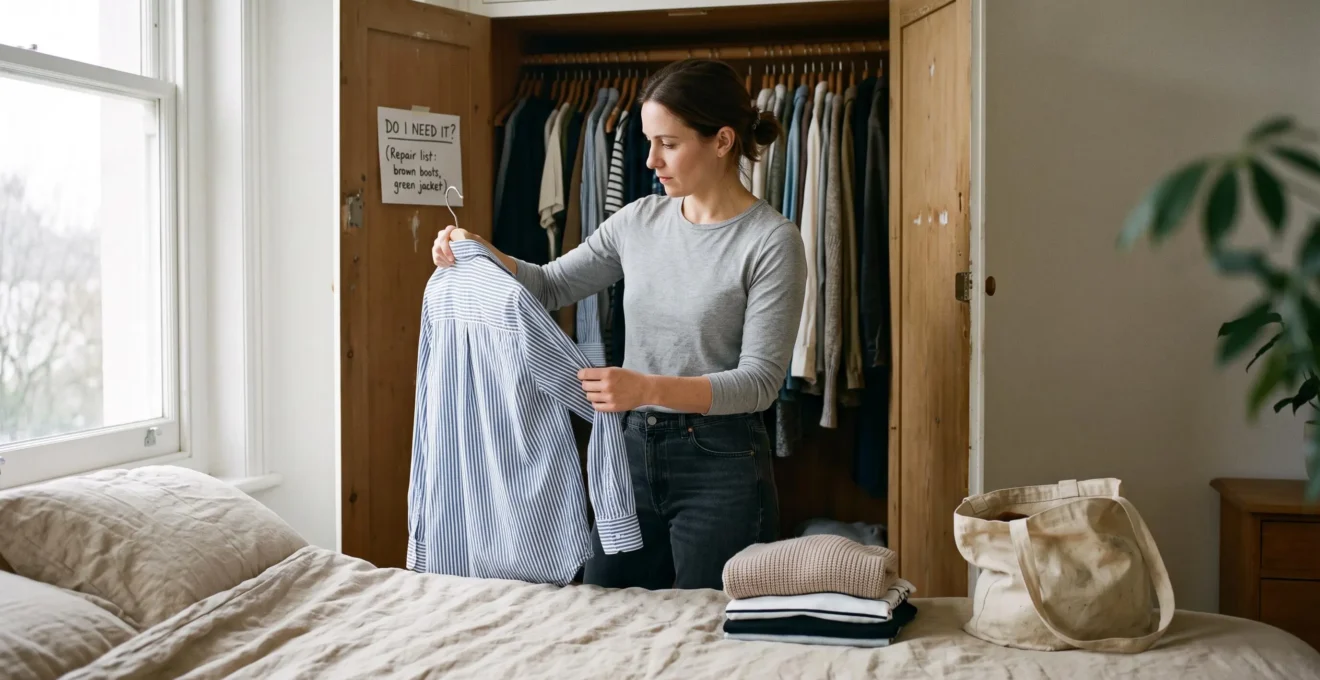
Conscious fashion consumption does not require a perfectly sustainable wardrobe, expensive ethical brands or hours spent researching every purchase. It means making more deliberate decisions about what enters your wardrobe, how long you use it and what happens when you no longer need it.
That distinction matters when shopping is shaped by limited budgets, inconsistent sizing, unpredictable schedules and confusing environmental claims. A supposedly responsible purchase can still become unnecessary clutter. Meanwhile, a conventional garment already owned and worn regularly may be more useful than replacing it with a newly marketed sustainable alternative.
The practical starting point is to reduce unnecessary purchases, choose clothing you will genuinely wear and build habits that survive ordinary life. Buying second-hand, checking certifications, repairing or reselling can support those habits, but none needs to become an obligation at every opportunity.
Rather than measuring yourself against an ideal shopper, measure whether your clothing decisions become more intentional over time.
Conscious fashion without the pressure to be perfect
- Start with fewer unnecessary purchases instead of replacing your wardrobe with supposedly better products.
- Use three affordable shopping rules and evaluate quality, fit and environmental claims before paying.
- Choose the circular-fashion habits that fit your available time, rather than trying to thrift, repair and resell everything.
- Why Does Conscious Shopping Make Some People Buy More After 30 Days of “Trying to Be Good”?
- How to Set 3 Conscious Shopping Rules You Can Actually Follow on a Normal Budget?
- Which Reduces Your Impact More: Buying 30% Less or Buying 20% Better Quality Pieces?
- The Green Claim Mistake That Tricks Shoppers Even When They Read the Tag Carefully
- When Is Second-Hand the Smartest Choice and When Does New Make More Sense for Fit?
- How to Verify Organic Cotton Claims in 5 Checks So You Don’t Pay for a Label Only?
- How to Resell 5 Items in 30 Minutes a Week Without Getting Stuck on Photos and Pricing?
- How Can You Do Circular Fashion When You Don’t Have Time to Thrift, Resell, and Repair Everything?
Why Does Conscious Shopping Make Some People Buy More After 30 Days of “Trying to Be Good”?
Some shoppers buy more after a period of strict conscious consumption because restriction can create a desire for rewards, while previous ethical choices can make later purchases feel justified. This does not happen to everyone, and there is no established 30-day rebound rule. Recognising personal triggers is more useful than treating another purchase as a moral failure.
Imagine someone completing a month without buying fast fashion. At the end, they celebrate by ordering several items from an ethical clothing collection. The purchases may feel deserved because they followed a period of restraint.
One possible explanation is moral self-licensing: doing something perceived as good can reduce attention to other ethical considerations. A PLOS ONE study on ethical consumption and moral self-licensing examines this mechanism in consumer choices. It does not demonstrate that fashion shoppers predictably overspend after 30 days.
Two useful practical patterns can help distinguish shopping triggers. These are diagnostic categories, not scientifically established consumer types:
| Pattern | Typical trigger | Practical response |
|---|---|---|
| Deprivation rebound | Feeling restricted, then treating shopping as a reward | Replace absolute bans with a realistic spending allowance and planned exceptions. |
| Compensatory rebound | Buying an ethical product to offset guilt or demonstrate commitment | Evaluate whether the item is needed before evaluating its sustainability credentials. |
To identify your own pattern, keep a simple record for one month. Note purchases, moments when you wanted to shop, the circumstances and whether you actually needed something. Look for reward triggers after achieving a goal or impulse triggers during stress, boredom and scrolling.
This is a personal observation exercise, not a validated diagnostic test. Its value lies in making shopping behaviour visible without turning every temptation into evidence of weak willpower.
Rigid zero-exception rules may be difficult to maintain, particularly when clothing needs change unexpectedly. A gradual approach allows ordinary purchases without treating them as proof that your overall effort has failed.
The next step is replacing broad promises with a small number of rules that work on both ordinary and difficult days.
How to Set 3 Conscious Shopping Rules You Can Actually Follow on a Normal Budget?
Choose three conscious-shopping rules that describe specific actions, can be checked immediately and do not require buying expensive sustainable products. A useful starting set is waiting before non-essential purchases, checking whether an item fills a genuine wardrobe gap and estimating its likely cost per wear. The goal is consistency, not perfect compliance.
Rules such as “always shop ethically” sound meaningful but require interpretation every time you enter a shop. Rules such as “wait 48 hours before ordering non-essential clothing” translate a value into a testable action.
Use three criteria when designing each rule: specific, testable and budget-neutral. Three is a manageable starting number, not a scientifically established optimum. It keeps the system short enough to recall at checkout.
| Vague rule | Practical replacement | How to check it |
|---|---|---|
| Only buy sustainable fashion. | Wait 48 hours before buying non-essential clothes. | Check when the item was first added to your wishlist. |
| Stop making wasteful purchases. | Identify three outfits using clothes you already own before buying. | Write down or photograph the combinations. |
| Invest in better clothing. | Estimate cost per wear using comparable garments you already own. | Compare the expected use with your actual habits. |
These rules mainly cost attention and a little time, rather than additional money. They do not require certified brands, premium fibres or replacing affordable clothes that still work.
For example, a garment costing $40 and worn 40 times has a purchase cost of $1 per wear. That is only a budgeting illustration, not an environmental impact measurement. Maintenance, alterations and other ownership costs may also matter.
A rule also needs a failure protocol. If you buy something impulsively, record what happened. Was the purchase urgent, emotionally driven or prompted by a misleading discount? Decide whether the rule needs an exception or a clearer reminder.
One mistake should not lead to abandoning the other two rules. The objective is to make your next decision easier, not to maintain an uninterrupted record of perfect behaviour.
Once those rules are established, it becomes easier to decide whether reducing purchase volume or improving garment durability deserves more attention.
Which Reduces Your Impact More: Buying 30% Less or Buying 20% Better Quality Pieces?
Buying 30% fewer garments is usually the more direct way to reduce new clothing demand, provided those purchases are genuinely avoided rather than postponed or replaced by other consumption. Buying 20% better-quality pieces can help when greater durability leads to longer actual use. Neither percentage automatically translates into an equivalent reduction in environmental impact.
The comparison is more complicated than it initially appears. Buying less affects the number of items entering your wardrobe. Buying better affects how well an item performs, how long it lasts and whether it needs replacement.
The European Environment Agency assessment of textile design and circularity identifies reduced consumption, longer use, reuse and improved durability as approaches that can reduce environmental pressures. Its findings concern European textile systems; they do not establish a universal outcome for this hypothetical 30%-versus-20% comparison.
Consider a person who buys 20 garments in a typical year. Buying 30% fewer would mean purchasing 14 rather than 20. This is a straightforward reduction in garment count, but it does not prove a 30% reduction in carbon emissions, water use or another environmental indicator.
Now consider buying garments described as 20% better quality. Unless quality is defined through measurable durability, repairability or performance, that percentage has no consistent environmental meaning.
| Shopping pattern | Best starting lever | Reason |
|---|---|---|
| Frequently replacing clothing for trends | Buy fewer items | Reduces unnecessary turnover and new demand. |
| Regularly replacing worn-out essentials | Prioritise durability | Longer useful life may reduce replacement frequency. |
| Buying many supposedly ethical pieces | Reduce purchases first | Better labels do not make unnecessary purchases necessary. |
| Keeping most garments for years | Maintain and repair | Preserves the usefulness of an existing wardrobe. |
The main quality trap is confusing price with durability. Expensive clothing can still pill, stretch, fade or remain unworn because it does not suit your lifestyle.
Before buying, examine seams, fabric performance, care requirements and repair potential. Then estimate how frequently you would wear the garment based on comparable clothing you already own, rather than the lifestyle you hope to adopt.
Actual use matters more than imagined use. A coat worn repeatedly across several seasons may justify careful selection. A statement jacket purchased for an idealised future wardrobe may not.
Trying to optimise every attribute simultaneously can also create excessive research and shopping attention. If purchasing volume is the main issue, focus on that first. Improve durability criteria when a genuine replacement becomes necessary.
With purchase volume under control, the next challenge is recognising when sustainability marketing describes a genuine attribute and when it creates an impression that goes beyond the evidence.
The Green Claim Mistake That Tricks Shoppers Even When They Read the Tag Carefully
The most important green-claim mistake is assuming that a true statement about one part of a garment proves the entire product is environmentally preferable. A label might accurately describe a fibre, recycled component or production step without establishing the garment’s overall impact. Reading carefully helps only when you also ask what the claim covers and who verifies it.
Terms such as “conscious,” “earth-friendly” and “responsibly made” may create a favourable impression without identifying a measurable environmental characteristic. Even a specific claim can invite an unsupported conclusion about the whole garment.
The US Federal Trade Commission‘s summary of the Green Guides on environmental claims cautions against broad, unqualified claims such as “green” or “eco-friendly.” It also explains why environmental benefits and certifications need clear qualifications.
Three broad categories help when evaluating a clothing label:
- Independent certification: A named third-party system assesses specified attributes against a defined standard. The certification’s scope still matters.
- Brand self-declaration: The company makes a claim about its product or manufacturing practices. Supporting evidence may be available, but independent verification is not established merely by the statement.
- Descriptive marketing wording: Positive environmental language appears without a clear standard, measurable claim or identifiable verification process.
For example, “made with organic cotton” describes an agricultural or material attribute. It does not, by itself, verify garment dyeing, finishing, manufacturing conditions, shipping impacts or total product emissions.
The critical question is therefore not simply “Is this claim true?” but “What exactly has been verified?”
A practical reading sequence is to identify the claimed attribute, find its supporting standard or evidence and check whether that evidence applies to the actual product being sold.
Regulatory treatment differs across the United States, United Kingdom, Canada, Australia and the European Union, and requirements continue to evolve. A US regulatory guidance document should not be treated as the complete legal standard for every English-speaking market.
This is why a transferable verification habit is more useful than memorising a long list of supposedly trustworthy labels.
A convincing claim should support a decision, not replace the basic question of whether a garment fits your needs and will actually be worn.
When Is Second-Hand the Smartest Choice and When Does New Make More Sense for Fit?
Second-hand clothing is often a sensible choice when sizing is flexible, condition is easy to assess and the item fills a genuine need. Buying new can be reasonable when precise fit, support, hygiene preferences or reliable returns matter more. The strongest choice is the garment you can comfortably use for a long time, not automatically the one labelled second-hand.
Second-hand shopping can extend garment use without requiring the production of an equivalent new item for that purchase. However, the environmental result depends on whether the purchase replaces something you would otherwise buy, how the item is used and other circumstances.
Fit deserves particular attention because second-hand listings may provide inconsistent measurements, limited photographs and restrictive return conditions.
| Garment category | Practical fit considerations | Suggested approach |
|---|---|---|
| Relaxed knitwear and oversized outerwear | Generally more forgiving silhouettes, though fabric shrinkage matters | Good second-hand candidates when measurements and condition are available. |
| Casual shirts and loose trousers | Fit depends on personal preferences and measurements | Compare garment dimensions with something you own. |
| Tailored jackets and fitted trousers | Shoulder, waist, rise and proportion can be difficult to adjust | Prefer try-ons, reliable measurements or alteration options. |
| Shoes and supportive garments | Comfort, structural support and previous wear matter | Inspect carefully and consider new where fit cannot be verified. |
| Intimate garments | Hygiene, material condition and personal comfort requirements | New may be the more practical choice, depending on the item and seller policies. |
These are practical shopping heuristics, not scientifically established environmental rankings. An adjustable second-hand jacket can still fit poorly, while a carefully measured tailored garment may be an excellent purchase.
The overlooked variable is the total cost of a wrong fit. A low-priced second-hand purchase may become expensive when returns are unavailable and the garment must be altered, resold or donated.
Before committing, check garment measurements, condition photographs, the seller’s return policy and the potential alteration cost. Compare those factors with the price difference between second-hand and new.
A new pair of well-fitting trousers worn regularly can make more practical sense than several second-hand pairs that remain unused. That example illustrates a decision principle, not a proven universal life-cycle comparison.
Conscious consumption leaves room for selective new purchases while maintaining second-hand as the default in categories where it works well.
Where new clothing is necessary, environmental claims can still inform the decision, provided they are checked at the correct level of detail.
How to Verify Organic Cotton Claims in 5 Checks So You Don’t Pay for a Label Only?
Verify an organic cotton claim by identifying its certification, understanding the certified scope, checking available certificate details, examining fibre percentages and confirming that the evidence applies to the garment itself. A credible fibre claim does not necessarily certify the whole production chain. If product-level evidence remains unavailable, treat the claim as unverified rather than assuming either fraud or full compliance.
Organic cotton claims can describe different levels of verification. Cotton may be organically grown, while later processing steps are assessed under separate criteria or not independently verified through the same claim.
The Global Organic Textile Standard, or GOTS, is one example of a textile certification system that addresses more than agricultural fibre origin. Its certification framework includes requirements for relevant textile processing stages, but it should not be interpreted as proof of a product’s entire environmental footprint.
The official GOTS certified-suppliers database provides a starting point for checking certified entities. The presence of a supplier does not automatically prove that every garment it sells is certified.
Two documents are especially important within the GOTS system. A Scope Certificate identifies an entity and its certified activities, while a Transaction Certificate relates to specific certified deliveries. Individual shoppers may not be able to access the latter.
The five-check organic cotton verification routine
- Identify the standard and certifier. Record the exact certification name and the organisation identified as responsible for certification. Deliverable: a named standard and certifier, or a note that either is missing.
- Determine what is certified. Check whether the evidence concerns fibre origin, processing activities or a certified textile product. Deliverable: one sentence describing the verified scope.
- Look for traceable certification documentation. For a GOTS claim, check available supplier records, Scope Certificate details and validity; ask about product-specific Transaction Certificate evidence when appropriate. Deliverable: a certificate reference or a documented verification gap.
- Read the fibre composition. Distinguish a garment described as organic cotton from a blend containing organic cotton, and record the stated percentages. Deliverable: the exact material composition shown on the product.
- Match evidence to the product. Confirm that the claim concerns the garment, rather than merely another product, a supplier or the brand’s general sourcing practices. Deliverable: a product-level conclusion of verified, partially supported or unverifiable.
Not every certification programme uses the same documentation or verification method. The certificate checks above are specifically framed around GOTS where relevant, rather than as universal requirements for every organic textile label.
Similarly, a product described as an organic cotton blend should not be assumed to meet a particular textile standard merely because its ingredients include organically grown fibre. The applicable standard’s composition and labelling requirements need to be checked separately.
Reasonable verification has limits. A shopper can inspect public records, product labels and supporting documentation, but cannot independently audit an entire international supply chain during an ordinary purchase.
If the seller cannot clarify a product-level claim, you can simply decline to pay an additional premium on the basis of that unverified attribute.
Verification should make shopping more informed, not so complicated that every replacement becomes a lengthy investigation.
How to Resell 5 Items in 30 Minutes a Week Without Getting Stuck on Photos and Pricing?
Reselling five clothing items in a 30-minute weekly session is a practical target when you prepare everything in batches, reuse one photo setup and apply the same pricing method. It is not a guaranteed duration: complex garments, platform requirements and buyer messages may take longer. The purpose is to minimise repeated decisions and prevent unused clothing from becoming another ongoing project.
The main time-saving principle is to process five items through one workflow rather than completing five separate workflows. Gather the garments, check their condition and prepare a clean, well-lit surface before opening your resale platform.
For ordinary mid-range clothing, start with a minimum viable listing: one clear full-garment photograph, a detail photograph and an honest description covering brand, size, measurements when useful, condition and defects.
Additional photographs may be necessary for fit-sensitive or high-value items. The aim is not to provide insufficient information, but to avoid spending disproportionate time staging routine listings.
Here is an illustrative 30-minute allocation:
| Time allowance | Action | Output |
|---|---|---|
| 5 minutes | Gather and inspect five garments | Five items ready to photograph |
| 8 minutes | Photograph each item using the same setup | Clear overview and detail images |
| 5 minutes | Check comparable completed sales where available | One realistic asking price per garment |
| 10 minutes | Write concise descriptions and create listings | Five submitted listings |
| 2 minutes | Record listings and the next review date | A simple follow-up reminder |
The schedule is a planning exercise, not a measured industry benchmark. If you are new to the platform, a smaller batch may be more realistic.
For pricing, completed or sold listings are more informative than asking prices because they offer evidence of what buyers have actually paid. Compare similar garments by condition, size, material and brand, where reliable data is available.
A useful personal shortcut is to start slightly below the median of comparable sold prices when a quick sale matters more than maximising proceeds. This is a suggested selling strategy, not a guaranteed conversion method.
Set an exit rule before listing. For example, review an unsold item after two weeks, reconsider the price after four and decide whether to donate it after six. Those intervals are adjustable personal deadlines, not evidence-based sales thresholds.
The point is to avoid the sunk-cost trap: continuing to store an item simply because its original purchase price makes accepting a lower resale value uncomfortable.
Also account for platform fees, shipping requirements, packaging costs and buyer communication. Reselling is worthwhile only when the expected return justifies the work involved.
When even a short resale session is too demanding, giving useful clothing directly to someone who needs it or using an appropriate donation channel may be the better practical option.
Key takeaways before building your routine
- The most sustainable wardrobe routine is one you can continue when money, time and attention are limited.
- Direct effort towards the main source of unnecessary consumption instead of performing every circular-fashion activity.
- Set defaults for both incoming and outgoing clothes, so individual decisions require less repeated effort.
How Can You Do Circular Fashion When You Don’t Have Time to Thrift, Resell, and Repair Everything?
You can practise circular fashion without doing everything by selecting one or two habits that fit your schedule and wardrobe needs. Start by limiting unnecessary purchases, then choose a manageable way to extend garment use or pass clothing on. Consistency over several months matters more than completing every second-hand, resale, repair and recycling activity each week.
Circular fashion aims to keep materials and products in productive use, reduce waste and avoid unnecessary demand for new resources. For an individual shopper, that can translate into several different behaviours rather than one comprehensive checklist.
Buying fewer clothes requires little dedicated weekly time, although changing purchasing habits may take effort. Wearing existing clothes longer can involve basic care. Repairs require tools, skills or access to services. Reselling creates ongoing listing and communication tasks. Second-hand shopping may save money but sometimes demands more searching and fit evaluation.
The appropriate choice depends on the constraint you actually face.
| Habit | Time commitment | Most useful when |
|---|---|---|
| Avoid an unnecessary purchase | Low ongoing time once a decision rule exists | You tend to buy more clothing than you use. |
| Care for existing garments | Small recurring effort | Clothes lose usefulness because of avoidable damage or neglected care. |
| Repair or alter clothing | Variable; may require learning or a service provider | An otherwise useful garment has a fixable problem. |
| Buy second-hand | Variable search and fit-checking time | Suitable, reliable used options are readily accessible. |
| Resell unwanted items | Recurring listing, packing and communication effort | Resale value justifies the time involved. |
| Donate or pass clothing on | Occasional sorting and delivery | Items remain wearable but resale is impractical. |
This table compares practical effort, not quantified environmental savings. Those savings depend on actual garment use, replacement behaviour, transport, care and other life-cycle factors.
A minimum viable circular wardrobe needs only two default rules.
For incoming clothing: use what you already have first, and buy only when a genuine need remains. When buying, select the option most likely to fit, last and be worn.
For outgoing clothing: decide whether an item can be repaired, reused by someone else or directed to an appropriate textile collection or recycling channel. Textile collection does not guarantee fibre-to-fibre recycling, and local systems differ.
During a busy month, the routine can become even simpler: postpone non-essential purchases and keep unwanted clothing in one designated place until you have time to deal with it.
There is no requirement to replace every damaged garment with a repair project. Some repairs are impractical, unaffordable or insufficient to restore the garment’s intended function.
Likewise, not every unworn item deserves an online listing. A wardrobe full of pending resale projects is still a wardrobe demanding attention.
Comparing yourself with people who publicly document extensive thrift hauls, clothing transformations and zero-waste routines can make ordinary efforts seem inadequate. Those visible examples do not establish a reasonable minimum for everyone.
Instead, assess your direction over time. Are you making fewer unnecessary purchases? Are more garments being worn regularly? Do unwanted items have a clearer exit route? Those questions are more useful than counting how many sustainability activities you completed this week.
Choose one habit to practise during your next month of clothing decisions. Keep it simple enough for a busy week, observe what changes and adjust only when the routine becomes manageable. Conscious fashion works best as an ongoing practice, not a test of personal perfection.
Can you be a conscious fashion consumer while still buying fast fashion occasionally?
Yes. Conscious fashion consumption is about deliberate decisions, not membership in a perfect shopping category. Buying fewer unnecessary items, wearing clothing regularly and maintaining it can be meaningful practices regardless of where every garment was purchased. This does not eliminate the wider environmental or labour concerns associated with production, but occasional purchases need not invalidate your overall efforts.
Do you need to throw away unsustainable clothes to create an ethical wardrobe?
No. Replacing wearable clothing simply because its label no longer reflects your values can generate unnecessary purchasing. Continue using garments that meet your needs, repair them where practical and make more deliberate choices when replacements become necessary.
How do you know whether a sustainable clothing purchase is worth the extra money?
First establish whether you need the garment. Then assess fit, likely wear frequency, durability, maintenance requirements and the specific evidence behind environmental claims. An additional price premium is easier to evaluate when it corresponds to verifiable characteristics and realistic use, rather than a general sustainability impression.
Is donating unwanted clothing always better than putting it in textile recycling?
Wearable clothing may be suitable for direct reuse when a recipient or organisation can genuinely use it. Damaged or unsuitable textiles may require a designated collection route. Check local acceptance rules, because donation systems and textile recycling capabilities vary, and collection does not automatically mean successful reuse or recycling.
What is the simplest way to measure progress without obsessing over sustainability?
Review your clothing purchases occasionally, such as once a month. Look at the number of unplanned purchases, how frequently new garments are worn and whether existing clothes are lasting longer. These are personal behavioural indicators rather than verified environmental impact measurements. Use them to identify useful changes, not to create another perfectionist scorecard.