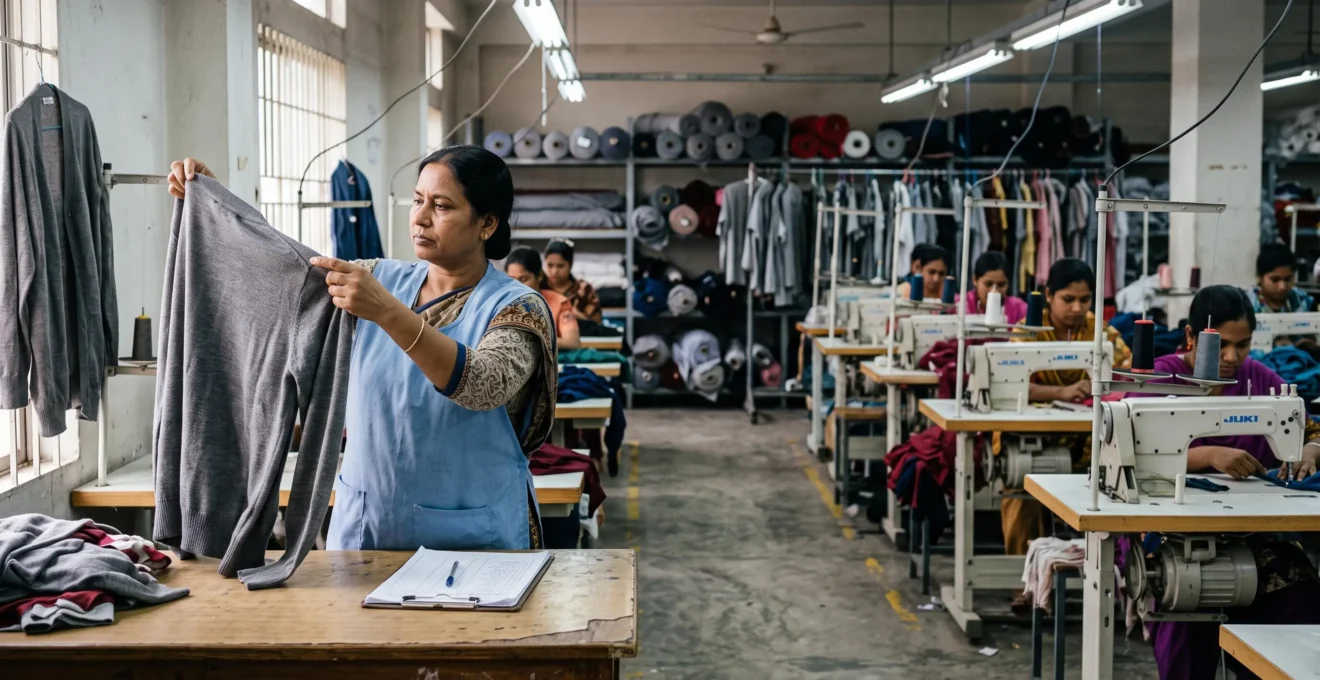
A clothing label tells you where a garment was made, but rarely reveals who produced its fabric, stitched its seams, or checked the working conditions behind it. Those unanswered questions matter because fashion supply chains influence both what you receive as a customer and how the people making your clothes are treated.
A fashion supply chain is the network of farms, fibre processors, spinning mills, fabric manufacturers, dyeing facilities, garment factories, subcontractors and distributors involved in bringing clothing to market. Different businesses may control different stages, and information does not always travel reliably between them.
Understanding this network does not require specialist industry knowledge. It requires knowing which claims can be checked, what certifications actually cover, and which gaps deserve further investigation. A named factory, a documented wage methodology or a verifiable certificate can be more informative than an impressive sustainability slogan.
The goal is not to eliminate every uncertainty before buying a shirt. It is to make better purchasing decisions by distinguishing meaningful evidence from assurances that cannot be independently assessed.
Fashion supply chains: what matters most
- Traceability matters more than brand reputation. A recognisable brand or manufacturing country cannot guarantee quality or fair working conditions.
- Certifications have defined limits. Check whether a label covers harmful substances, organic materials, manufacturing processes or labour practices before trusting its implications.
- Evidence should be specific. Named suppliers, worker protections, credible audits and documented corrective action are stronger indicators than general ethical promises.
- Why Do Complex Supply Chains Make It Harder to Trust Quality Claims Even From Big Brands?
- How to Evaluate a Brand’s Supply Chain Transparency in 10 Minutes Without Getting Lost
- Which Is More Reliable: Locally Made Clothing or Global Production With Strong Audits?
- The Certification Assumption That Can Mislead You About Working Conditions
- The 4 Supply-Chain Signals That Often Predict Longer-Lasting Clothes Before You Buy
- How to Verify Organic Cotton Claims in 5 Checks So You Don’t Pay for a Label Only
- How to Screen a Brand’s Ethical Production in 10 Minutes Using 6 Transparency Signals
- How Can You Tell if Clothing Is Ethically Produced When Brands Only Share Vague Claims?
Why Do Complex Supply Chains Make It Harder to Trust Quality Claims Even From Big Brands?
Complex fashion supply chains make quality and ethical claims harder to verify because responsibility is distributed among businesses that may not share complete information. A major brand can impose manufacturing standards on its direct suppliers without knowing every subcontractor involved. Brand size may provide auditing resources, but it does not automatically provide visibility into every production stage.
Consider a hypothetical clothing company that orders jackets from a contracted factory. That factory purchases fabric from an independent mill, sends embroidery to another workshop and occasionally outsources sewing to meet delivery deadlines. The brand might approve the original contractor without directly inspecting every location where work takes place.
This structure creates several potential weaknesses:
- Incomplete supplier records: A brand may identify its final assembly factories while knowing substantially less about mills, dyeing facilities or informal subcontractors.
- Inconsistent quality controls: Different workshops may interpret construction requirements differently unless inspections and specifications are consistent.
- Limited worker visibility: Home-based workers and employees of subcontractors may be absent from the brand’s regular monitoring systems.
- Fragmented accountability: When defects or labour complaints arise, responsibility can be disputed between contractors and production partners.
Large brands can face these problems even when they invest in compliance teams. Managing numerous suppliers across changing collections requires maintaining accurate records, identifying unauthorised subcontracting and validating information supplied by other businesses.
52%
Of the 250 major fashion brands and retailers assessed in 2023 disclosed their first-tier supplier lists. This historical finding measures public disclosure, not the ethical performance of individual factories.
Fashion Revolution’s 2023 Fashion Transparency Index findings
The distinction between a marketing claim and verifiable evidence is crucial. “Our products meet rigorous standards” describes an intention or asserted practice. A published supplier list, defined inspection requirements and reports explaining how deficiencies were corrected offer more opportunities for scrutiny.
Supply-chain complexity is a reason to investigate, not proof of misconduct. A complicated network can be responsibly managed, while a short network can conceal serious problems. The relevant question is whether each significant production stage is identified and subject to meaningful oversight.
Once the limits of brand-level promises become clear, the next step is to establish how much of a company’s manufacturing network is visible to an ordinary shopper.
How to Evaluate a Brand’s Supply Chain Transparency in 10 Minutes Without Getting Lost
You can assess a fashion brand’s supply-chain transparency in approximately ten minutes by looking for named manufacturing facilities, checking the scope of public disclosures and investigating whether problems are acknowledged and corrected. The objective is not to audit an entire company. It is to determine whether its claims are supported by specific information that outsiders can examine.
Start with the brand’s website rather than a general internet search. Look under headings such as “Suppliers”, “Our Factories”, “Traceability”, “Sustainability” or “Responsible Sourcing”. A supplier map or downloadable factory list is usually more informative than a page describing company values.
Use this time-limited routine:
- Minutes 0–2: Find the supplier list or manufacturing map. Note whether it identifies actual facilities or only countries.
- Minutes 2–4: Check whether the disclosure includes addresses, facility types and production stages beyond final assembly.
- Minutes 4–6: Scan the sustainability report for named audit organisations, inspection scope and findings.
- Minutes 6–8: Compare disclosed suppliers with an independent resource such as Open Supply Hub, where relevant records are available, or consult historical transparency assessments for context.
- Minutes 8–10: Look for corrective-action reporting, including how identified problems were addressed and whether improvements were subsequently checked.
To interpret what you find, use four practical disclosure levels.
| Disclosure level | What the brand publishes | What it allows you to check |
|---|---|---|
| Facility-level | Named suppliers, locations and production activities | Specific facilities and potentially independent information about them |
| Country-level | Manufacturing countries without factory names | Geographical distribution, but not individual facilities |
| General statements | Broad sourcing policies and ethical commitments | Declared intentions, with limited external verification |
| No meaningful disclosure | Little or no supplier information | Very little about the actual manufacturing network |
Watch for transparency theatre: extensive reports, polished photography and ambitious targets that provide little information about facilities or outcomes. Also check coverage. A brand may disclose suppliers for one sustainable capsule collection without offering comparable information about its main catalogue.
A published audit pass rate is not necessarily decisive. More useful reporting identifies recurring problems, corrective measures and follow-up results. A company acknowledging a documented issue may provide more substantive evidence than one claiming that every inspection was successful without explaining its methodology.
Your five-action transparency checklist
- Find the brand’s supplier page and save the link or a screenshot of its most specific disclosure.
- Identify one named manufacturing facility and record its location and production activity.
- Check which production stages are covered and write down any missing stages, such as dyeing or subcontracted sewing.
- Find the brand’s audit or worker-protection information and record the named auditing body or monitoring method, if disclosed.
- Locate one documented corrective-action outcome, or record clearly that no such outcome was found.
Transparency is not the same as ethical performance, but it determines how much scrutiny is possible. This distinction becomes particularly important when deciding whether local manufacturing deserves more trust than international production.
Which Is More Reliable: Locally Made Clothing or Global Production With Strong Audits?
Neither locally made clothing nor internationally manufactured clothing is automatically more reliable. Local production may simplify communication and physical oversight, but proximity does not guarantee fair wages or consistent workmanship. Global production can offer credible safeguards when factories are identified, workers have meaningful channels to raise concerns, and independent monitoring produces documented improvements.
The expression “locally made” describes geography, not a complete production system. A garment sewn domestically may contain imported fabric, thread, zippers and buttons. Even its final assembly may involve several workshops rather than one company-controlled facility.
Local workshops can also rely on informal subcontracting or home-based piecework. These arrangements are not inherently unethical, but they can become difficult to scrutinise when workers are excluded from normal employment protections or supplier disclosures.
International production presents different oversight challenges. Geographical distance can complicate direct visits, communication and monitoring of subcontractors. However, an overseas factory operating under clearly defined specifications and meaningful worker-protection systems may be better documented than an unidentified domestic workshop.
Compare the options using evidence rather than geography alone.
| Assessment criterion | Locally made clothing | Global production with audits |
|---|---|---|
| Production visibility | Potentially easier to visit, but suppliers still need identification | Depends on named facilities and access to reliable records |
| Quality control | Can benefit from direct communication and nearby inspections | Can benefit from established specifications and repeated monitoring |
| Labour conditions | Cannot be inferred from the country of manufacture | Require worker-level evidence beyond audit declarations |
| Audit credibility | Depends on independence, scope and follow-up | Depends on independence, scope and follow-up |
| Subcontracting risk | May involve informal or home-based production | May involve additional facilities across multiple production tiers |
Audits also deserve scrutiny. An announced inspection provides an opportunity to examine records and processes, but a factory knows when auditors are arriving. Unannounced inspections may reveal different conditions, although they are not automatically comprehensive or reliable. Independence, worker interviews, complaint mechanisms and documented remediation all matter.
A sensible purchasing rule is to favour local production when the brand identifies its makers and explains how conditions are monitored. For international production, look for named factories, credible independent assessments, worker-voice mechanisms and evidence that corrective actions are implemented.
Location should inform the questions you ask, not settle the decision. Certification labels can provide additional information, but only when their actual requirements are understood.
The Certification Assumption That Can Mislead You About Working Conditions
The most misleading assumption about fashion certifications is that a certified garment must have been made under fair working conditions. Certification systems assess different subjects, including textile chemistry, organic production, chain of custody or labour practices. A certificate can be valid within its defined scope while leaving important questions about wages, working hours and worker rights unanswered.
OEKO-TEX STANDARD 100 illustrates the distinction. Its focus is testing textiles for harmful substances. This is relevant to product safety, but it does not establish that workers receive living wages or that a factory provides effective freedom of association.
The official OEKO-TEX STANDARD 100 certification requirements explain the harmful-substance testing scope, which can cover textile components and finished products. Consumers can also use the organisation’s label-verification service to investigate certificate information.
Other standards address different concerns:
- GOTS: Covers specified organic textile processing requirements and includes environmental and social criteria within its defined certification framework. It should not be reduced to a fibre-content label, nor interpreted as proof that every worker receives a living wage.
- OEKO-TEX STANDARD 100: Focuses on harmful-substance testing rather than comprehensive workplace ethics.
- SA8000: Addresses defined social-accountability requirements for certified organisations and their management systems.
- Fair Trade certifications: Can include social and economic requirements, but the applicable programme, product coverage and certified entities must be identified before drawing conclusions.
Even social-compliance certifications have limitations. Audits evaluate evidence gathered through a particular process and within a particular period. Working conditions may change, subcontracting may remain undisclosed, and employees may not always feel safe discussing problems openly.
For this reason, an inspection record should not be treated as a permanent guarantee. Ask when the assessment occurred, what activities and facilities were covered, how workers were consulted and what happened after non-compliance was identified.
A stronger approach combines certification scope, supplier identification and corrective-action evidence. The three answer different questions: what requirements apply, where production occurs, and how problems are handled.
Be especially cautious when brands display a certification logo without naming the standard, supplying verifiable identification or explaining whether it applies to the material, the factory or the finished garment.
Certifications can reduce uncertainty about specific claims, but they are not substitutes for understanding the companies and processes behind a garment. Some of those same disclosures may also help you investigate durability.
The 4 Supply-Chain Signals That Often Predict Longer-Lasting Clothes Before You Buy
Four useful supply-chain signals can help you investigate a garment’s likely durability: stable manufacturing partnerships, traceable materials, practical repair support and consistent production runs. These factors can indicate better opportunities for quality control, but none independently guarantees that clothing will last. Physical construction, fabric performance and appropriate care remain essential checks.
1. Long-term factory relationships or vertical integration.
A brand that owns certain production stages or works consistently with identified manufacturing partners may have opportunities to refine patterns, communicate defects and maintain repeatable construction standards. Long relationships, however, provide no guarantee unless quality expectations are documented and enforced.
Look for named manufacturing partners, evidence of continuing collaboration and descriptions of actual inspection practices rather than vague references to craftsmanship.
2. Fabric and component traceability.
Knowing where a fabric was woven, how it was specified or which manufacturer supplied a technical component can make material claims easier to assess. A named mill or certification does not automatically indicate abrasion resistance, colourfastness or seam strength, but traceability gives the customer more information to question.
For technical garments, relevant performance specifications may be more informative than descriptions such as “luxury-grade” or “premium cotton”.
3. Repair guidance and replacement components.
Brands that provide repair instructions, replacement buttons, spare hardware or accessible mending services make it easier to extend a garment’s useful life. These services demonstrate practical support for repairability, although their presence alone does not prove superior manufacturing quality.
Check whether repair options apply to the product you are buying, whether parts remain available and whether any stated service conditions are clear.
4. Stable collections and repeatable production.
When a brand produces established designs repeatedly, manufacturers may have more opportunities to refine patterns and address recurring defects. Rapidly changing product lines can introduce additional coordination pressures, but collection frequency alone is not a reliable measure of workmanship.
Compare the brand’s product history with observable details: stitching consistency, seam alignment, fabric density appropriate to the garment, secure attachments and clear care instructions.
The strongest purchasing assessment combines supply-chain information with a direct examination of the garment. Turn clothing inside out, inspect stressed seams and consider whether replacement parts or repairs would be realistic.
Durability claims become more useful when they describe materials and construction rather than relying on prestige. Organic cotton provides a good example of why the precise meaning and verification of a material claim matter.
How to Verify Organic Cotton Claims in 5 Checks So You Don’t Pay for a Label Only
Verify an organic cotton claim by checking the exact certification, understanding the claimed fibre content, investigating how materials were traced through production, reviewing supplier disclosures and questioning unsupported pricing narratives. A legitimate certification can establish specific facts, but an organic label on its own does not prove that every manufacturing stage or the finished garment meets the same requirements.
These five checks help separate verifiable information from marketing language.
- Identify the certification. Look for the full name of the standard, the relevant certification body and any applicable licence or certificate details. A recognisable logo without sufficient identification is difficult to investigate.
- Read the claim precisely. “Organic cotton”, “made with organic cotton” and “organic cotton blend” can communicate different fibre-composition claims. Check the actual percentage and any requirements attached to the named standard. Terms such as “natural” or “eco” do not, by themselves, establish certified organic status.
- Investigate chain of custody. Organic fibre may pass through spinning, weaving or knitting, dyeing and garment assembly. Ask whether the finished product is covered by the claimed certification and what documentation supports the movement of certified materials through those stages.
- Check supplier disclosure. Named mills, processors and manufacturers can help connect a claim to real businesses. A company that identifies only its cotton-producing region gives you less information to verify.
- Examine price and volume claims cautiously. A very low price or repeated discount may justify asking questions, but it does not prove that organic cotton claims are false. Inventory decisions, product specifications, margins and commercial strategy also influence prices.
For GOTS-related claims, the official GOTS Certified Suppliers Database provides a way to investigate certified companies and their approved activities. A database entry should not be interpreted as certification of every garment produced by that business.
When searching the certification database, compare the supplier’s identity, location, certification activities and relevant product categories against the brand’s statements. If an entry cannot be found, do not immediately conclude that the company is uncertified: the official database acknowledges that certification bodies may still be updating information.
A further distinction is essential: certifying an organisation is not identical to verifying a particular retail product. Evidence supporting the finished garment’s certification may require additional documentation, depending on the standard and the claim being made.
Likewise, organic cotton should not be confused with a general durability guarantee. Fibre cultivation methods and garment longevity are separate questions. Yarn construction, fabric structure, finishing, stitching and use all influence performance.
A credible material claim answers one important question. To understand whether the people processing and sewing that material are treated responsibly, the investigation must extend to labour-specific evidence.
How to Screen a Brand’s Ethical Production in 10 Minutes Using 6 Transparency Signals
Screening ethical clothing production means checking whether a brand provides verifiable information about its suppliers, wages, worker representation, independent monitoring, subcontracting rules and corrective actions. Six targeted signals can reveal the strength of its public accountability within ten minutes. They cannot prove that every worker is treated fairly, but they can expose where important evidence is missing.
Focus on labour conditions rather than environmental slogans or fibre certifications. A brand may provide extensive carbon-footprint information while saying little about the people sewing its clothes.
The following signals help establish whether its ethical commitments are supported by operational details.
- Named supplier facilities. Look for factory names, countries, addresses and facility types. Confirm whether disclosures include relevant subcontractors and production stages rather than final assembly alone.
- A defined living-wage methodology. Check whether the company identifies a wage benchmark, explains how wages are measured and publishes meaningful progress. A minimum-wage compliance statement is not equivalent to evidence of living-wage payment.
- Worker voice and representation. Look for concrete information about trade unions, collective bargaining, grievance channels or worker-driven monitoring. A complaints hotline is more informative when employees can access it safely and its outcomes are disclosed.
- Identified audit organisations. Determine who conducts assessments, whether monitoring is independent and what is reported about findings. A claim that factories are “regularly audited” provides little detail without an identifiable process.
- Rules covering subcontractors. Find a published supplier code of conduct and check whether its requirements extend beyond direct suppliers. Policies need practical implementation mechanisms to have meaningful effect.
- Incident and remediation reporting. Look for information about violations, corrective actions, worker remedies and subsequent monitoring. Problems that are openly documented and addressed provide more assessable evidence than unsupported statements of perfect compliance.
Not all six signals deserve equal weight. A named supplier list and a measurable wage methodology are particularly informative because they provide concrete subjects for verification. However, both can still be incomplete or misleading if the underlying information is inaccurate.
99%
Of the 250 major brands assessed in Fashion Revolution’s 2023 transparency study did not disclose how many supply-chain workers received a living wage. The statistic concerns disclosure in that historical sample, not proof that those workers were unpaid or underpaid.
Fashion Revolution, Fashion Transparency Index 2023.
Cross-check meaningful claims beyond the brand’s own website. Relevant sources can include union statements, documented NGO investigations, worker-led initiatives and independent transparency assessments. Consider the date, scope and evidence behind each external account rather than treating any single rating as definitive.
Pay attention to the one-good-collection problem. A company might provide extensive ethical sourcing information for a limited product range while disclosing far less about the rest of its business. Check whether supplier lists and wage commitments apply company-wide or only to selected products.
The result of a ten-minute screen should be a short evidence-based assessment: what is independently checkable, what remains a company assertion and what is entirely undisclosed.
Gaps in disclosure do not automatically establish unethical production. They do, however, determine how much confidence a shopper can reasonably place in claims that depend on evidence the brand has not shared.
Key takeaways before making a purchase
- Distinguish a brand’s ability to document its suppliers from its ability to demonstrate fair treatment of workers.
- Prioritise independently checkable information and outcomes over future promises, attractive labels or manufacturing-country stereotypes.
- When critical evidence is missing, record the uncertainty explicitly rather than assuming the worst or accepting the claim at face value.
How Can You Tell if Clothing Is Ethically Produced When Brands Only Share Vague Claims?
When a fashion brand uses vague ethical language, treat its claims as unverified until it provides evidence about suppliers, labour standards and how problems are addressed. Ask specific questions, compare the answers with independent information and distinguish measurable achievements from commitments. Missing evidence does not establish wrongdoing, but it limits the confidence you can place in the claim.
Marketing language often compresses complicated manufacturing practices into reassuring expressions. Translating these expressions into concrete questions makes them easier to evaluate.
| Brand statement | Evidence to request |
|---|---|
| “Ethically sourced” | Named suppliers, documented sourcing requirements and evidence of implementation |
| “Responsibly made” | Factory locations, worker-protection measures and monitoring outcomes |
| “Our factories follow high standards” | Named standards, relevant audit bodies, assessment scope and corrective-action records |
| “We care about workers” | Wage methodology, worker representation and accessible grievance processes |
| “Certified sustainable” | The exact certification, its scope, applicable entities and verifiable status |
When public information is insufficient, contact the brand directly. A concise message is more likely to receive a useful response than a broad question about whether the company is ethical.
For example:
“I’m considering purchasing one of your garments and would like to understand its manufacturing conditions. Could you share your current factory list, identify the independent organisations involved in monitoring labour standards, and explain which wage benchmark you use for production workers? If this information is publicly available, a link to the relevant documentation would be helpful.”
Evaluate the substance of the reply. Does it answer the questions, identify relevant documents and clarify which products are covered? A prompt response with precise evidence can be helpful. A slow response is not automatically suspicious, and a quick generic reassurance is not proof of responsible production.
Regulation may also provide useful information, although requirements vary across English-speaking markets. In the European Union, the Corporate Sustainability Due Diligence Directive establishes a framework for specified human-rights and environmental due diligence obligations affecting qualifying very large EU and non-EU companies.
The European Commission‘s explanation of corporate sustainability due diligence describes the amended framework, including changes adopted in 2026. The amended main requirements generally apply from 26 July 2029, with the relevant reporting measures applying to financial years beginning on or after 1 January 2030.
This legislation is not a universal obligation for every fashion company, nor is it a certification of ethical clothing. Its application depends on company size, turnover, jurisdiction and the relevant legal requirements. Other English-speaking countries have their own regulatory approaches, which should be assessed separately.
For the consumer, the practical rule remains consistent: absence of evidence means uncertainty, not automatic guilt or innocence. The importance of that uncertainty will depend on the purchase, the strength of alternative evidence and how much risk the buyer is willing to accept.
Inexpensive everyday clothing and high-priced garments both deserve scrutiny when ethical claims influence a purchasing decision. A premium price does not independently verify wage practices, just as a low price does not establish exploitation.
Before your next clothing purchase, choose one important claim, identify the evidence needed to support it and spend ten minutes checking whether that evidence exists. If the answer remains unclear, ask the brand a specific question or compare a better-documented alternative. That small investigation makes a purchasing decision more informed without requiring certainty that no supply chain can realistically promise.
Does a higher clothing price mean better working conditions?
No. A higher retail price can reflect materials, design, distribution, marketing or brand positioning rather than higher worker wages. To assess working conditions, look for a defined wage methodology, named production facilities and credible evidence of labour monitoring. Price alone cannot establish ethical manufacturing.
Can a clothing brand be transparent without being ethical?
Yes. Transparency concerns information a brand makes available, while ethical performance concerns actual practices and outcomes. A company may publish extensive supplier information while still facing unresolved labour problems. Transparency makes scrutiny easier but does not replace evidence of fair treatment, worker protections or effective remedies.
Why might a certified textile still have quality problems?
Certification covers the requirements of a particular standard, which may concern organic processing, harmful substances or other defined criteria rather than durability. A certified fabric can still be poorly cut, stitched or assembled. Assess fabric characteristics, seam construction and care requirements separately from certification claims.
Is a missing supplier name proof that a brand is hiding unethical practices?
No. A missing name means the specific supplier cannot be verified from the information available. There may be different reasons for nondisclosure, and it is not evidence of a particular labour violation. However, the absence reduces independent scrutiny and is a reasonable reason to request more details before trusting broad ethical claims.
What should shoppers do if independent information contradicts a brand’s ethical claims?
Check whether both accounts concern the same facility, production period and allegations. Consider the reliability and date of each source, then look for documented responses, corrective measures and independent follow-up. An unresolved contradiction is a reason to withhold confidence, not to assume either account is automatically conclusive.