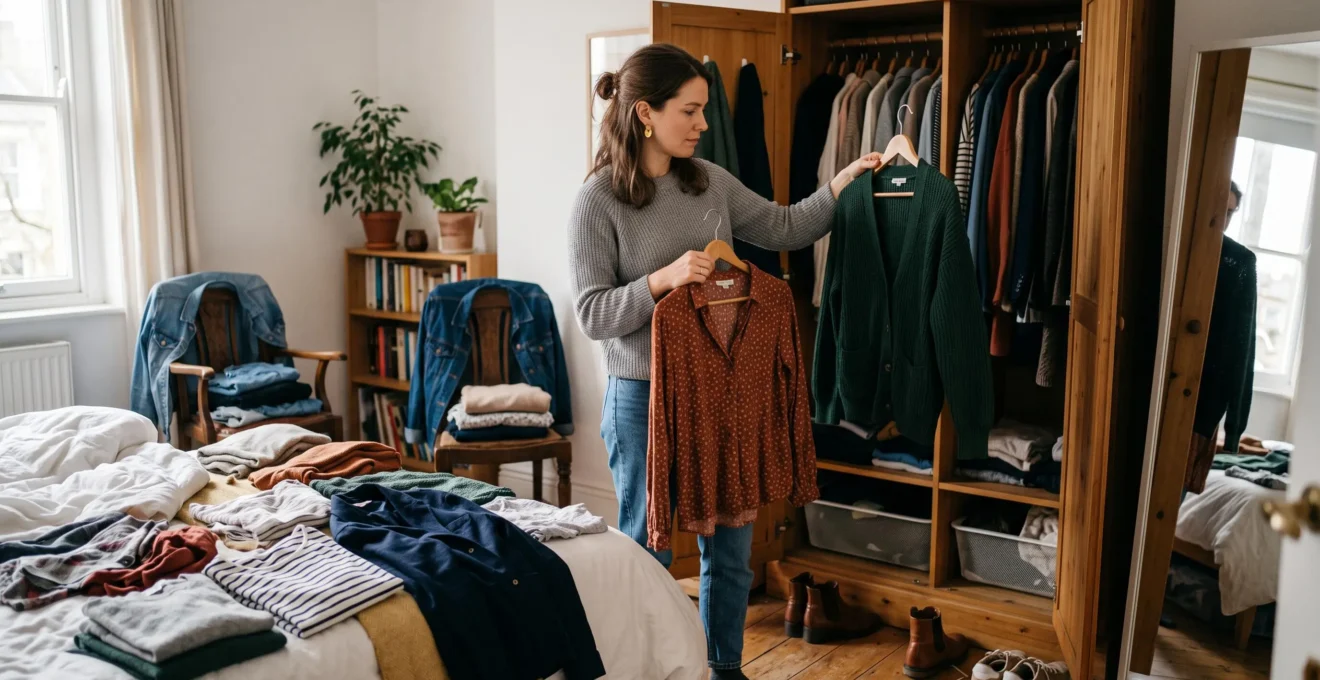
Six months ago, your ideal outfit might have been oversized jeans, sneakers, and a relaxed blazer. Today, you are saving pictures of tailored trousers, fitted tops, and structured coats. Everything you liked before suddenly feels less interesting, and your wardrobe seems to belong to a different version of you.
But changing what attracts you does not necessarily mean losing your personal style. A consistent style is not a fixed aesthetic or a collection of clothes you must love forever. It is a recognizable set of preferences that can adapt to new influences, responsibilities, and circumstances.
The most useful way to define your personal style is to identify what you repeatedly wear, establish a few consistent visual preferences, and test new directions before buying into them. This creates continuity without requiring you to ignore trends or dress identically every day.
The goal is not to stop your taste from changing. It is to make those changes easier to understand, more intentional, and less expensive.
Personal style that evolves without constant wardrobe resets
- Identify your real preferences through frequently worn outfits, not just inspirational images or aesthetic labels.
- Build a stable wardrobe foundation with enough flexibility to accommodate different moods and occasions.
- Experiment with new directions for 30 days before committing to purchases, using comfort, repeat wear, and everyday practicality as your evidence.
- Why Does Your Style Feel “Different” Every Season Even If Your Personality Hasn’t Changed?
- How to Find Your 3 Style Keywords Using Only the Outfits You Wore 20+ Times
- Which Builds Stronger Personal Style: a Signature Uniform or a 3-Lane Style Range?
- The Aesthetic-Label Mistake That Makes You Buy Clothes You Never Actually Wear
- A Simple 30-Day Style Test That Lets You Evolve Without Wasting Money on Wrong Purchases
- How to Create Outfit Harmony Using 3 Echoes So You Stop Overthinking Matching
- Why Do “Contemporary” Pieces Look Current for 2 Years While Some Trends Die in 3 Months?
- What Counts as Contemporary Clothing and How Do You Wear It Without Looking Dated Fast?
Why Does Your Style Feel “Different” Every Season Even If Your Personality Hasn’t Changed?
Your style can feel different every season because your exposure to fashion, your daily environment, and your immediate attractions change faster than your established clothing preferences. A new aesthetic may suddenly seem more appealing without replacing what you genuinely enjoy wearing. Distinguishing temporary inspiration from lasting preference helps explain this apparent instability.
Consider how frequently you encounter new visual influences. Social media feeds, seasonal collections, celebrity outfits, and changing street-style trends continually introduce different ideas of what looks desirable. After seeing the same silhouette repeatedly, it may begin to feel more natural or relevant than something you previously loved.
That does not automatically mean your personality or underlying preferences have changed. It may simply mean your attention has shifted.
A useful distinction is between attraction and established taste. Attraction describes what catches your eye right now. Established taste becomes visible in the clothing you voluntarily choose and enjoy wearing across ordinary situations.
For example, you might spend a week admiring dramatic leather jackets while continuing to reach for soft knitwear and relaxed tailoring. Both reactions are genuine, but they provide different information. One shows curiosity; the other demonstrates an established preference.
Social comparison can also influence how satisfied you feel with your appearance. A 2023 experiment involving 230 women aged 17–25 found that exposure to Instagram influencer imagery increased negative mood, appearance comparison, and body dissatisfaction compared with viewing fashion-product images. The Flinders University research on Instagram influencers and body image does not establish that social media changes personal clothing preferences, but it offers a reason to distinguish appearance dissatisfaction from actual wardrobe needs.
Try observing how you feel immediately after scrolling through aspirational fashion content, then compare it with how you feel after getting dressed in an outfit you already enjoy. If dissatisfaction mainly appears after scrolling, the problem may be comparison rather than your wardrobe itself.
Changes in circumstances deserve a separate assessment. A new workplace, different climate, altered social routine, or move to another city can make previously useful clothes less practical.
Write down the three situations you dressed for most often six months ago, then the three you dress for today. If those lists differ, your wardrobe requirements may have changed even if your preferred colors, textures, and proportions have not.
Research published in Frontiers in Psychology in October 2026 examined clothing, self-expression, and social identity among 312 Bangladeshi university students. Its qualitative findings identified comfort, authenticity, social expectations, and context-dependent clothing choices as recurring themes. The Frontiers in Psychology study on clothing, self-expression and social identity supports considering everyday circumstances alongside self-expression, although its specific sample cannot represent all consumers or establish how preferences change over time.
Before replacing your clothes, look for evidence of continuity. The pieces you still wear comfortably may reveal a more stable identity than the aesthetics currently filling your feed.
How to Find Your 3 Style Keywords Using Only the Outfits You Wore 20+ Times
To find your three personal style keywords, examine outfits or garments you have voluntarily worn roughly twenty times or more, then identify their recurring silhouette, color family, and formality level. These repeated choices provide a practical starting point because they reflect what works in your actual life rather than what looks appealing in an inspiration folder.
Start with clothes that have repeatedly earned a place in your week. They do not need to be expensive, visually striking, or particularly fashionable. A pair of relaxed black trousers worn constantly may reveal more about your personal style than a statement dress you bought enthusiastically and wore once.
The number twenty is a useful reflection threshold, not a scientifically validated measure of authentic taste. If you do not track individual wears, use laundry habits, outfit photographs, or your memory of frequently repeated combinations to identify likely candidates.
Look at several favorites together. Instead of naming aesthetics such as minimalist or romantic, describe the actual qualities they share.
- Silhouette: relaxed, fitted, structured, flowing, straight, or oversized.
- Color family: muted neutrals, warm earth tones, cool colors, saturated shades, or monochromatic combinations.
- Formality: casual, polished, tailored, sporty, or occasion-focused.
Suppose your most-worn outfits repeatedly feature straight-leg trousers, charcoal or navy pieces, and slightly polished combinations. Your three keywords might be straight, muted, polished.
These words are useful because they describe characteristics you can recognize across different garments, brands, and fashion seasons.
Now test whether the keywords can guide decisions. When considering a new purchase, ask: “Does this item match at least two of my three keywords?”
Imagine a bright, heavily embellished skirt catches your attention. If your usual preferences are muted, straight, and polished, the skirt might fit only the polished category. That does not make it a bad garment, but it suggests the purchase is an experiment rather than an obvious wardrobe addition.
The two-keyword rule is a flexible filter, not a requirement to reject everything unexpected. Its purpose is to help you recognize when excitement is overriding evidence of compatibility.
One important exception is clothing worn through obligation. A formal office dress code, limited laundry access, or a lack of alternatives can make certain items frequent choices without making them favorites.
For each repeated item, ask whether you would choose it again if you had several equally practical options. Separate clothes worn by preference from those worn mainly by necessity.
Your five-step personal style keyword audit
- Gather photographs or examples of ten frequently repeated outfits. Deliverable: a reference collection of ten real outfits.
- Mark the outfits or garments worn roughly twenty times or more, where you can estimate this reliably. Deliverable: a shortlist of repeat-wear favorites.
- Exclude pieces worn mainly because of a dress code or lack of alternatives. Deliverable: a refined list of voluntary favorites.
- Record the most common silhouette, color family, and formality level. Deliverable: three clearly defined style keywords.
- Evaluate three potential purchases against those keywords. Deliverable: a short keep, test, or reject decision for each item.
Once those preferences are visible, the next decision is how to organize them: through a repeatable signature look or a flexible range of related styles.
Which Builds Stronger Personal Style: a Signature Uniform or a 3-Lane Style Range?
Neither a signature uniform nor a three-lane style range automatically creates a stronger personal style. A uniform offers consistency and faster dressing when daily routines are stable. A three-lane range offers flexibility when occasions and preferences change frequently. Both work best when outfits share recognizable colors, proportions, or materials.
A signature uniform does not mean wearing the exact same garments every day. It means repeating a dependable outfit formula, such as straight trousers, a fitted knit, and a structured jacket, with variations in individual pieces.
A three-lane range divides your wardrobe into three related dressing modes. For example, you might have a polished lane for work, a casual lane for daily activities, and a statement lane for occasions when you want something more expressive.
The central difference is how each system accommodates variation.
| Decision factor | Signature uniform | Three-lane range |
|---|---|---|
| Daily decision-making | Faster, with familiar outfit formulas | More options, requiring some coordination |
| Changing routines | Best suited to relatively predictable needs | More adaptable to varied settings |
| Experimentation | Usually limited to variations within a formula | Built into separate style directions |
| Main risk | Feeling restricted or buying only to maintain the signature | Creating three disconnected wardrobes |
| Best consistency tool | Repeated silhouettes and outfit combinations | Shared colors, shapes, and materials across lanes |
The hidden weakness of a strict uniform is that it can become an obligation. You might feel that experimenting with a different silhouette means abandoning your identity. You might even continue buying a familiar category because it fits your signature, despite no longer needing it.
A three-lane system has the opposite risk. Without shared visual characteristics, its categories can become separate wardrobes that rarely mix, increasing both complexity and the temptation to purchase duplicates.
For someone whose taste shifts every six months, a hybrid approach is often a practical starting point.
Use a stable core for approximately two-thirds of your weekly outfits, then allow one or two smaller lanes for experimentation. This is a suggested organizational ratio, not a researched optimum. It gives reliable pieces a dominant role without requiring every outfit to look alike.
Hypothetical example: one wardrobe, three moods
Imagine someone who repeatedly wears navy trousers, cream knits, and brown leather accessories. These pieces form a practical core.
For casual days, the trousers are exchanged for relaxed denim. For more expressive occasions, the cream knit is replaced with a colorful textured top. The palette and familiar proportions connect the outfits, even when their moods differ.
You can often identify your natural system by observing replacement behavior. If you routinely buy another version of the same trousers when an old pair wears out, a signature uniform may suit you. If you enjoy changing silhouettes while consistently returning to the same colors or materials, a range may feel more natural.
The structure matters less than whether you can maintain it without fighting your habits.
Whichever model you use, avoid turning it into another rigid identity. A wardrobe system should organize your preferences, not decide which ones you are allowed to have.
The Aesthetic-Label Mistake That Makes You Buy Clothes You Never Actually Wear
The aesthetic-label mistake happens when you buy clothing because it belongs to a recognizable trend identity rather than because it suits your real routine. Labels such as cottagecore, clean girl, or old money can help describe visual inspiration, but they cannot determine whether an item will be comfortable, practical, or repeatedly worn.
Aesthetic labels are convenient shortcuts. They bundle silhouettes, colors, textures, accessories, and social associations into a recognizable visual category. Searching for an aesthetic can be a useful way to discover clothing you might otherwise overlook.
The difficulty begins when that label becomes an obligation.
Instead of asking whether a garment fits your lifestyle, you start asking whether it completes the aesthetic. A romantic blouse may look beautiful in a carefully styled photograph but require delicate laundering, special undergarments, and occasions you rarely attend.
Its appeal is real. Its compatibility with your routine may not be.
Before buying something inspired by a new aesthetic, try the routine-change test:
- Would wearing it require shoes you do not already own?
- Would it demand more maintenance than you normally tolerate?
- Would it need a different workplace, social calendar, or daily routine?
- Can you create several realistic outfits using clothes already in your wardrobe?
An item that requires multiple lifestyle changes deserves closer examination. The problem is not that you are incapable of adopting a different look. It is that buying the garment will not automatically create the circumstances needed to wear it.
Consider the difference between searching for “old money outfits” and searching for “straight tailored trousers in muted colors.” The first describes a broad visual identity. The second describes specific attributes that can remain useful even after the aesthetic loses popularity.
Use aesthetic names as search tools, not personal identity contracts. You can appreciate elements of a trend without committing to every garment associated with it.
Try describing your wardrobe without aesthetic labels. Replace “quiet luxury” with “clean lines, understated finishes, and relaxed tailoring,” or replace “romantic style” with “soft fabrics, curved details, and gentle colors.”
These descriptions help you understand what you actually find appealing. They also make it easier to combine influences that appear incompatible when treated as complete aesthetic categories.
A person can enjoy structured jackets and delicate blouses without needing to decide which trend identity is more authentic.
Once you can describe the features that attract you, you can experiment with them individually rather than replacing large sections of your wardrobe every time a new label becomes popular.
A Simple 30-Day Style Test That Lets You Evolve Without Wasting Money on Wrong Purchases
A 30-day style test gives a new fashion direction time to prove itself before you invest in it. For one month, recreate the look mainly with clothes you already own, document how the outfits feel during ordinary activities, and delay major purchases. The aim is to test wearability rather than rely on initial excitement.
Suppose you suddenly feel drawn to sharper tailoring after months of wearing relaxed casual outfits. Rather than immediately purchasing several structured pieces, spend a month experimenting with combinations already available in your closet.
You might tuck a familiar top into tailored trousers, layer a structured jacket over casual basics, or borrow an item that represents the direction you want to explore.
The test is deliberately limited. Use existing garments, restyle pieces in different combinations, borrow where practical, or consider no more than one low-cost experimental item if necessary. Keep larger purchases on a wishlist until the trial ends.
This is a personal decision framework, not a scientifically validated 30-day rule. Its usefulness comes from creating opportunities to observe your preferences under normal conditions.
The first part of the month is about experimentation. Try different combinations without expecting every outfit to work. What matters is whether the direction remains appealing once it encounters your actual routine.
After each wear, record three simple observations: how often you adjusted the outfit, whether you felt self-conscious in it, and whether it made you change or avoid any planned activities.
These signals can reveal practical friction that a mirror photograph does not capture. A fitted jacket might look excellent but feel restrictive during your commute. An unusual color combination might seem intimidating initially but become comfortable after a few wears.
Do not interpret every moment of unfamiliarity as failure. Different clothes can require adjustment simply because they are new to you. Look for recurring problems rather than judging one isolated experience.
At the end of the month, review which combinations you voluntarily repeated, which felt manageable, and which required effort you are unlikely to sustain.
Buying less while experimenting also has a broader practical rationale. According to the Ellen MacArthur Foundation analysis of circular fashion business models, the average number of wears per garment declined by 36% 2015. Those historical industry figures do not prove that a personal 30-day test reduces waste, but they provide context for prioritizing repeated use over unnecessary replacement.
If a direction fails, preserve what you learned. Write a brief exclusion note such as “stiff fabric becomes uncomfortable,” “requires shoes I never wear,” or “too much maintenance for weekdays.”
Over time, these notes can prevent you from repeatedly buying variations of the same impractical idea under different trend names.
A successful trial does not require you to buy anything. Sometimes discovering a new way to wear an existing outfit is enough to satisfy the desire for change.
How to Create Outfit Harmony Using 3 Echoes So You Stop Overthinking Matching
To create outfit harmony with three echoes, repeat one recognizable visual attribute in three places across an outfit. The repeated element can be a color, texture, material finish, or shape detail. Instead of matching entire garments exactly, this method creates continuity through small connections, allowing different styles and newer pieces to work together.
Traditional matching often focuses on whether two items are identical or closely coordinated. You might wonder whether your shoes are exactly the same brown as your belt, or whether your jacket and trousers belong to the same color family.
Echoing changes the question. Rather than asking whether two items match perfectly, ask whether a detail appears elsewhere in the outfit.
For example, a warm brown bag could echo the brown stitching on a jacket and the warm tone of a pair of shoes. Those elements do not need identical colors. Their shared visual quality creates a recognizable relationship.
You can build three echoes using different attributes:
- Color echoes: repeat a burgundy accent through a scarf, a bag detail, and a small element in your footwear.
- Texture echoes: connect a ribbed knit, textured socks, and a ribbed accessory through their surfaces.
- Shape echoes: repeat rounded forms through a curved neckline, a rounded bag, and soft-edged jewelry.
These are styling examples rather than universal rules of visual perception. The goal is to give your eye a few relationships to recognize without creating an overly controlled outfit.
A hypothetical combination might include dark jeans, a cream sweater, tan shoes, and a green jacket. A green hair accessory and a subtle green detail on the bag could create two additional appearances of the jacket’s color, connecting three otherwise separate elements.
The technique is especially useful during style transitions. If you start experimenting with contemporary pieces or unfamiliar silhouettes, you can connect them to established wardrobe favorites through familiar colors or materials.
This means new purchases do not necessarily require matching companion items. You can often create coherence through accessories and garments you already own.
One potential weakness is relying exclusively on indistinguishable neutral repeats. Three plain black elements may create consistency, but they might not provide much visual interest if the entire outfit is already black.
Try including a distinctive finish, a warm accent, an interesting texture, or another noticeable detail. The point is not to make every outfit colorful; it is to make the repetition feel intentional.
There is also no need to force exactly three visible repetitions into every outfit. Treat the method as a way to solve coordination problems, not another standard that every look must satisfy.
When you learn to create harmony through shared attributes, you become less dependent on buying specific sets of clothes. That flexibility is particularly valuable when exploring newer silhouettes and contemporary trends.
Why Do “Contemporary” Pieces Look Current for 2 Years While Some Trends Die in 3 Months?
Some contemporary pieces remain visually current longer because they combine broadly established design features with only a few trend-specific details. Short-lived fashion items often depend on several recognizable signals appearing together. However, two years and three months are illustrative timeframes, not reliable universal lifespans; actual relevance varies by garment, market, and styling context.
Consider two hypothetical jackets. The first has a relaxed cut, a neutral color, simple hardware, and a familiar fabric. The second combines an exaggerated cropped silhouette, a highly recognizable viral color, and an unusual decorative closure.
Both might look contemporary when purchased. But the second jacket depends on more specific design choices remaining desirable at the same time.
This is the basis of an attribute-count method for evaluating the risk of a garment quickly looking associated with a particular trend.
Before purchasing, inspect the piece for signals linked to a passing fashion moment:
- Cut: Does its silhouette depend on an especially distinctive proportion?
- Color or print: Is its appeal strongly connected to a currently prominent shade or pattern?
- Details: Does it feature conspicuous hardware, embellishment, or another trend-specific finish?
A piece with one highly recognizable trend signal may be easier to restyle later than one combining three. This is a qualitative shopping heuristic, not an empirically established formula for predicting fashion lifespans.
It also helps to distinguish slowly evolving design directions from narrow microtrends.
Relaxed tailoring, classic outerwear structures, and practical everyday fabrics can appear across multiple seasons, even as their proportions gradually change. In contrast, an unusually specific sleeve treatment or viral decorative detail may become strongly associated with a shorter fashion cycle.
The difference is not always obvious. An exaggerated silhouette can later become familiar, while a seemingly restrained item may lose appeal because its proportions no longer suit the wearer.
Style durability also depends on how easily a garment can be worn in different combinations. A jacket that works with multiple bottoms, shoes, and layers has more opportunities for continued use than one requiring a highly specific outfit.
There may be a financial consequence as well. If an item becomes difficult to style, its cost per wear can increase because you wear it less often. Resale may offer an alternative, but resale value depends on demand, condition, brand, and other factors; a high number of trend signals does not establish a predictable resale loss.
The practical question is therefore not “Will this still be fashionable in exactly two years?” but “How many different ways could I realistically wear this if its most recognizable trend details became less popular?”
The next step is to apply that reasoning to contemporary dressing itself, choosing current-looking clothes without expecting every piece to become a permanent classic.
Key takeaways before buying contemporary clothing
- Look beyond a garment’s fashionable label and identify the specific proportions, finishes, and details that make it appear current.
- Choose pieces that can work with established wardrobe favorites even when one seasonal feature becomes less prominent.
- Evaluate versatility and realistic wear opportunities alongside immediate visual appeal, rather than assuming that understated automatically means timeless.
What Counts as Contemporary Clothing and How Do You Wear It Without Looking Dated Fast?
Contemporary clothing reflects current design preferences through its proportions, fabrics, finishes, and styling without necessarily depending on a highly recognizable short-lived trend. To wear it without quickly looking dated, combine one noticeable current feature with familiar, adaptable pieces. This allows your outfits to evolve while maintaining visual continuity with your established personal style.
The word contemporary is sometimes used as a retail category, but it is more useful here as a description of how clothing relates to present-day design preferences.
A contemporary garment may feature updated tailoring, different proportions, a modern fabric treatment, or subtle changes in hardware. None of these automatically makes an item timeless or guarantees a particular lifespan.
When evaluating a piece, examine four practical attributes:
- Silhouette line: Look at where the garment sits on the body, how its volume is distributed, and how it interacts with other pieces.
- Fabrication: Consider fabric weight, drape, surface texture, and suitability for your actual routine.
- Hardware and finish: Notice buttons, zippers, decorative details, stitching, and overall construction.
- Palette: Assess whether its colors integrate with your existing clothes or require a separate set of accessories.
A helpful approach is the one-trend-signal rule. Build an outfit around one noticeably current element, then support it with at least two features that are less dependent on a particular fashion moment.
For instance, imagine experimenting with dramatically wider trousers. You could pair them with a simple knit and a familiar structured coat. The trousers introduce a new proportion, while the remaining pieces provide recognizable continuity.
Alternatively, a striking seasonal color might work within an outfit built around your usual silhouette and familiar materials.
This rule does not mean contemporary clothing must be neutral or understated. A bold piece can be entirely compatible with personal style when the rest of the outfit gives it a workable context.
It is also helpful to plan how you will use a purchase over time. If you genuinely enjoy a new piece, wear it regularly while it feels especially relevant rather than saving it indefinitely for an imagined perfect occasion.
As your interests change, try giving the item a different role. A once-prominent shirt might become a layering piece. A statement jacket could work with simpler outfits. An unfamiliar silhouette might become easier to wear as you discover new combinations.
There is no guarantee that an item will remain desirable, but restyling before replacing gives it more opportunities to remain useful.
This connects contemporary dressing with the broader goal of defining a stable personal style. Your repeat-wear preferences provide the foundation. Your three keywords help filter new additions. Your flexible wardrobe structure makes space for changing interests, and your 30-day trial helps determine whether those interests deserve a purchase.
Start with one outfit you already enjoy wearing. Identify its recurring colors, proportions, and level of formality, then experiment with just one contemporary element over the next month. You do not need to know what your style will look like in six months to build a wardrobe that still feels like yours today.
Can you have a personal style without choosing one aesthetic?
Yes. Personal style can be defined through recurring preferences in silhouette, color, texture, and formality rather than a single aesthetic label. You may enjoy several different visual influences while maintaining continuity through familiar proportions, materials, or outfit combinations. The important distinction is whether your clothes work together and suit your actual routine.
How many clothes do you need to discover your personal style?
There is no established minimum number of garments required. You can begin by examining a small selection of outfits you already repeat. Even a handful of voluntary favorites may reveal useful preferences. A larger selection can help distinguish consistent patterns from choices driven mainly by weather, work requirements, or limited alternatives.
What should you do if your favorite clothes no longer fit your lifestyle?
Separate the attributes you still love from the practical role those garments used to serve. If your routine has become more formal, you might preserve your preferred colors and relaxed silhouettes through different fabrics or more structured pieces. There is no need to discard everything immediately; identify actual gaps and address them gradually.
Is it worth keeping clothes from an aesthetic you no longer wear?
It depends on their usefulness, condition, available storage, and whether you still enjoy their individual attributes. A piece may work outside the aesthetic that originally inspired its purchase. Try restyling it with current favorites before deciding. Clothes that no longer fit your needs can be considered for resale, donation, repair, or other appropriate reuse options.
How can you experiment with fashion when your clothing budget is limited?
Begin with combinations of clothes you already own, experiment with styling details, and borrow suitable pieces when practical. Keep desired purchases on a wishlist while testing whether the look works in everyday situations. If a new direction remains appealing after repeated wear, prioritize a versatile addition that complements your existing wardrobe rather than buying an entire aesthetic at once.